
Daniel 7:6: Like a Leopard, Nimrod, and Orion
Part 6: Daniel Chapter 7 Like A Panther - Who Is The Third Beast?
Review
For new and old readers, please review the previous parts:
Part 1:

Part 2:

Part 3:

Part 4:

Part 5:

Part 6:
“like a leopard”?
Introduction
In Daniel Chapter 7, the Lion and the Bear have been associated celestially with Leo the Lion and Ursa Major, the Great Bear. Traditional interpretations have also associated the four beasts with historical kingdoms such as Babylon, Media-Persia, Greece, and Rome, respectively. However, using the celestial constellations, the first two beasts have also been correlated to the 2017 Solar Eclipse near the heart of the lion and the Comet of 2020 with three tails in the mouth of the bear. Let’s take a look at the third beast.
6 After this I looked, and behold, another, like a leopard, with four wings of a bird on its back. And the beast had four heads, and dominion was given to it.
Daniel 7:6, ESV1[emphasis added]
The following high-level questions will be answered,
What is like a leopard?
Did Daniel use wordplay again?
Who is the third beast?
Hypothesis: Daniel’s vision of a beast like a leopard is also in the Heavens and on Earth today and may have a spirit of Nimrod.
Lynx?
In Daniel 7:6, Daniel describes the third beast, “like a leopard”. When I began this research in 2025, I was so certain that the Lynx constellation was the third beast. See the Lynx constellation on the Northwest horizon with the setting sun. This would make so much sense with Leo, the 1st Beast, and the Great Bear, the 2nd Beast, along with the Lynx, the 3rd Beast. All three constellations are clustered together.
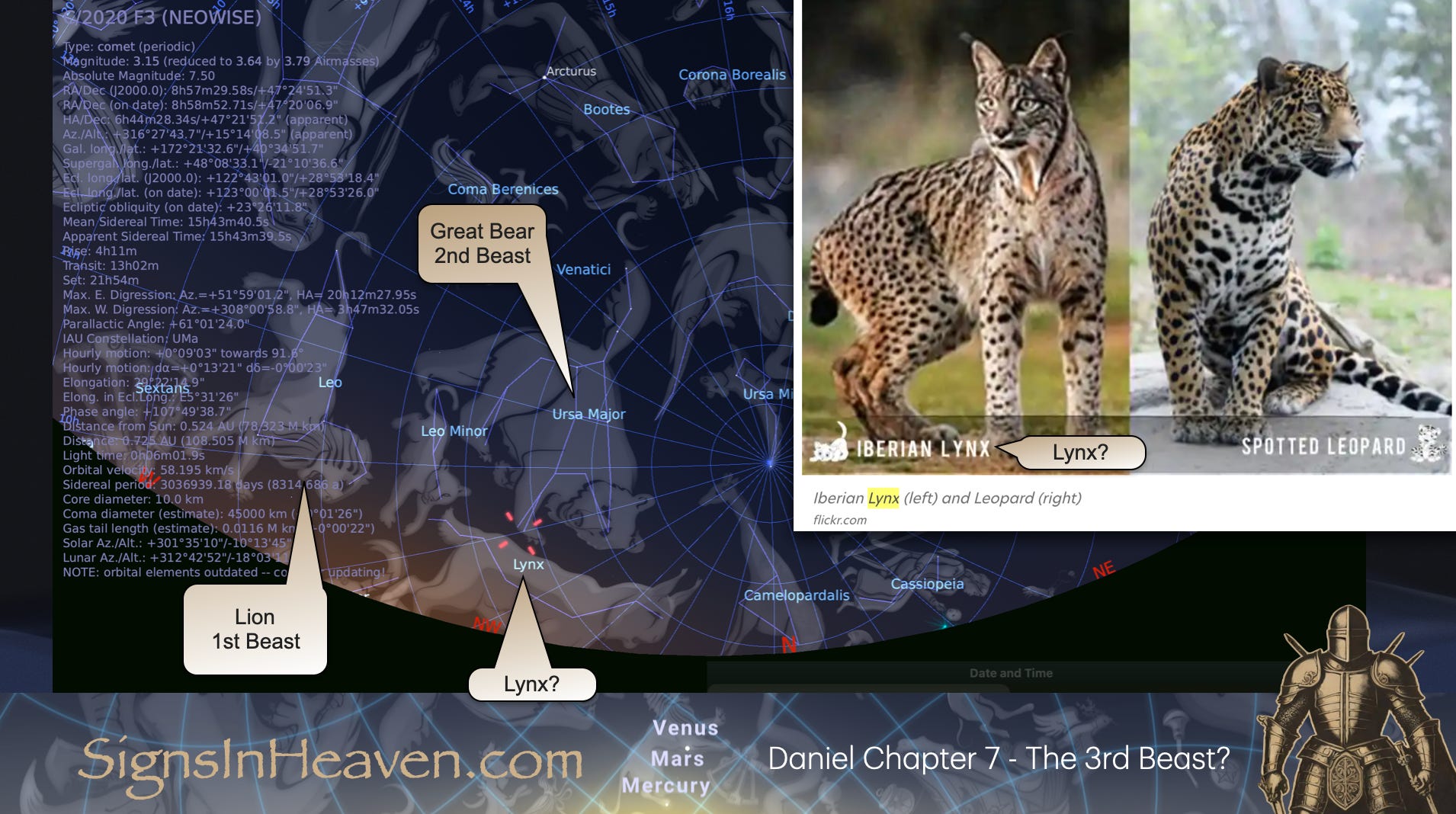
(source: Stellarium June 19th, 2020 - Looking North after sunset, Comet NEOWISE in the bear, photo - flickr.com)
Furthermore, the Lynx shown on the left is often mistaken for a spotted leopard. However, unfortunately, the Lynx is a modern constellation created by Polish astronomer Johannes Hevelius in 1687 AD.2 Therefore, this constellation did not exist in c600 to 500 BC at the time of Daniel. The Lynx is not one of the original 48 Mazzaroth constellations, but it is one of the 88 constellations, which includes modern constellations.3
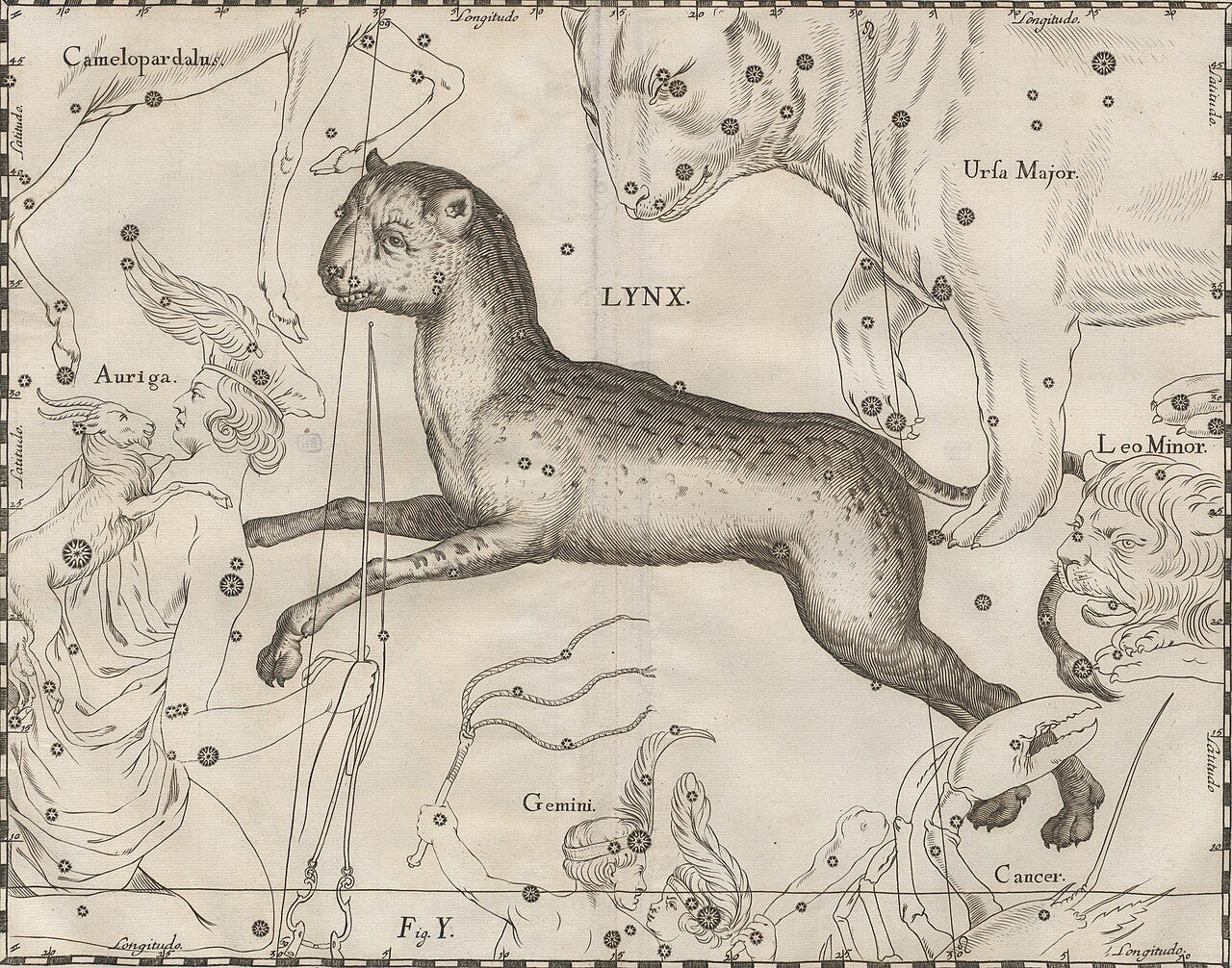
(source: public domain, Jan Heweliusz)4
So we need to dig deeper into Babylonian starlore, but let’s start with a word study. If Daniel used an idiom for “rib” in the second beast, what about the word “leopard”?
Leopard Word Study
“Leopard” happens to be another idiom, nem-ar, is a Chaldaism, an ancient Aramaic homonym.
5245. נְמַר nemar (Chald.), nem-ar´; corresp. to 5246:—leopard.
In Wiktionary, the Assyrian Neo-Aramaic is nimrā, denoting leopard, panther, jaguar, and even tiger.
Etymology: Inherited from Aramaic נִמְרָא (nimrā), from Proto-Semitic *namir-; compare Arabic نَمِر (namir), Hebrew נָמֵר (namér) and Akkadian 𒊊𒌉 (nimrum).
Noun: ܢܸܡܪܵܐ • (nimrā) m (plural ܢܸܡܪܹ̈ܐ (nimrē), feminine ܢܸܡܪܬ݂ܵܐ (nimrṯā))
leopard, panther, jaguar
(proscribed, dialectal) tiger
The noun, nimrā, and Nimrod both start with the same first four letters, “nimr”. Strong’s Concordance 5245 also corresponds to 5246, which notes the relationship to Nimrod 5248.
5246. נָמֵר nâmêr, naw-mare´… a leopard (from its stripes):—leopard. נְמְרֹד Nimrôd, See 5248.5
5248. נִמְרוֹד Nimrôwd, nim-rode´6
There is a possibility that Daniel is using another wordplay that correlates leopard and Nimrod to convey a deeper meaning - what could this be?
The origin of the name Nimrod is uncertain. Some say it is Akkadian (northern Babylonian), stemming from the god of war and hunting, Ninurta, denoting “the arrow, the mighty hero.”
In historical mythology, Nimrod’s identity as the Bible’s first “mighty hunter” was tied to the panther. According to these traditions, his name was interpreted from Chaldean/Aramaic fragments to mean “The Subduer of the Leopard” (from Nimr for leopard, and rad to subdue).7. One can conclude that the Nimrod and Nimru relationship was known in Babylon, where Daniel resided.
How would a leopard and Nimrod be related celestially?
Nimrod and Orion
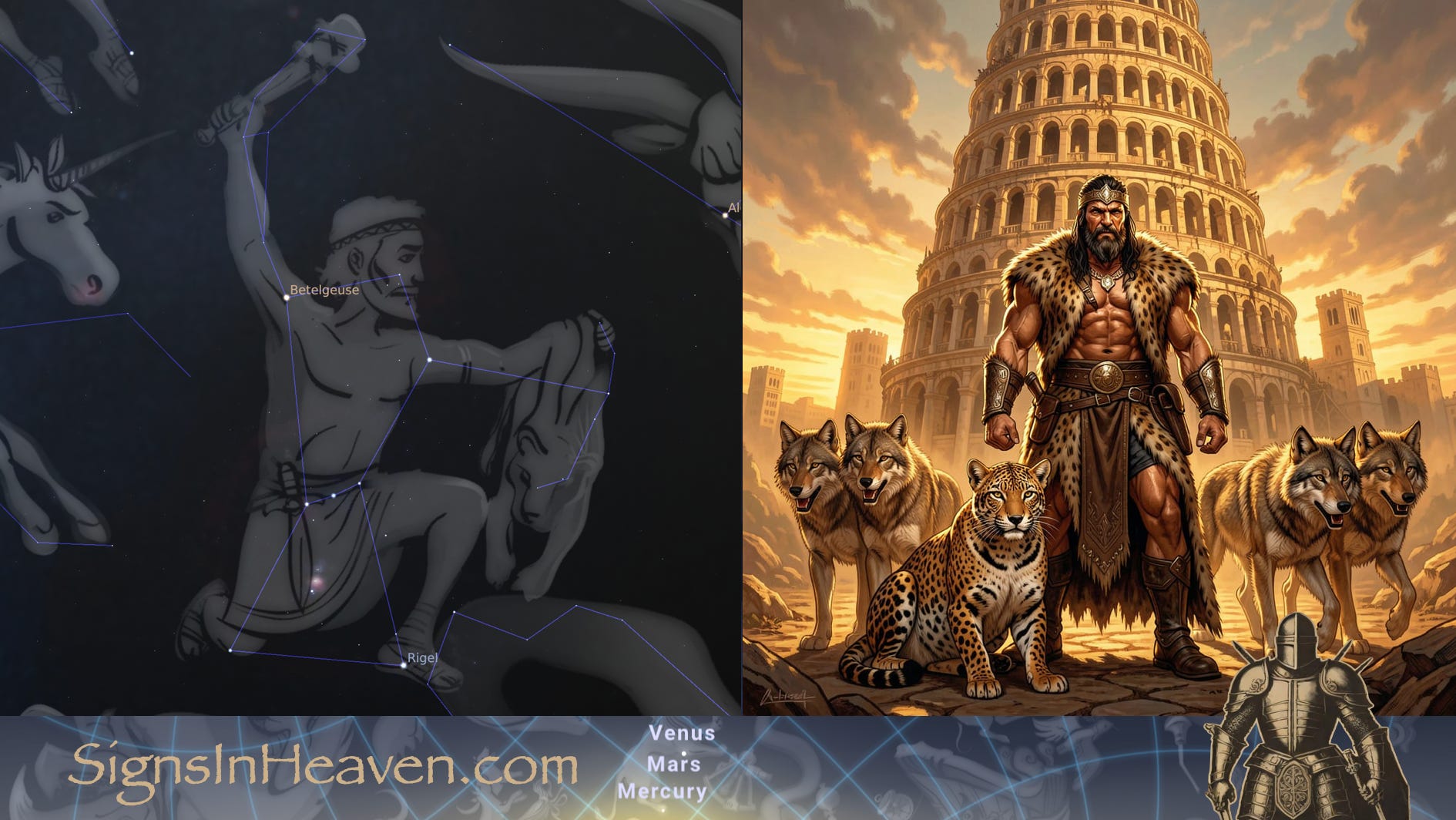
(source: Stellarium - Orion; Night Cafe - Nimrod)
One of the most recognized constellations, next to the Big Dipper, is Orion (Job 9:9, 38:31). The familiar constellation is visible as a large rectangle with three slanted stars for the belt and three vertical stars for the sword attached to the belt. There is a red star, like a ruby, in the sword. Orion is a hunter carrying the body or pelt of a big cat, a lioness, leopard, jaguar, or panther.
Pictured to the right is an AI rendering of Nimrod standing before the Tower of Babel. He is a hunter, wearing a leopard pelt. “The Subduer of the Leopard” has a tamed leopard at his side, along with four canines ready for the hunt. He was a fierce aggressor, a warrior-king, and had a passion for the chase. Nimrod was known as a mighty hunter, and legend says he learned to tame big cats. Thus, we show Nimrod as the leopard tamer.
Scholars have associated Nimrod with Orion. The Jewish Encyclopedia states,
The Aramaic and Syriac names of Orion have been connected with the ancient Oriental tradition that Nimrod, who is called in the Bible a hero and mighty hunter, was fettered by God for his obstinacy in building the tower of Babel, and was set in the sky (Winer, "B. R." ii. 157). It is possible that the ancient Hebrews saw in this constellation the figure of a man who was naturally regarded as extraordinarily tall and strong, exactly as the Greeks named it "Orion,"… (Schiaparelli, l.c.).8
The McClintock and Strong Biblical Cyclopedia also references similar text that,
…the constellation of the Giant — that is, Orion (q.v.) — was named from Nimrod; and some have identified Nimrod with the Greek Orion (comp. Movers, Phon. p. 471; Baur, Amos, p. 351), who was also a giant (Odys. 11:309 sq.; comp. II. 18:486, σθένος ᾿Ωρίωνος; Hesiod, Works and 'Days, 580, Pliny, 7:16) and a mighty hunter (Odys. 11:574). The Hebrew kesil' (כּסַיל.) is rendered Orion (Isa 13:10; Job 38:31) by the Syriac and the Sept. The word means a fool, an impious person, applied naturally to a proud blasphemer; and the chains or "bands of Orion" (Job 38:31) may be explained in the same way (see Michael. Spicel. 1:209 sq.; Suppl. p. 1319 sq.; comp. Gesen. Comment. on Isaiah 1:458 sq.).9
Nimrod was tall like Orion, and a proud fool who did not have respect for God and blasphemed the God of Heaven and Earth.
The Lexham Bible Dictionary describes Nimrod,
According to Philo of Alexandria, Nimrod’s ancestors epitomize “evil and spiritual unproductiveness,” which can only result in giants (van der Horst, “Nimrod after the Bible,” 221–22). Later in the Jewish legends (Hag. 13a; Pesahim 94b) Nimrod is described as the archetypal evil king who made all the people rebel against God (Hamilton, Genesis, 338). He is also noted as the builder of the tower of Babel and the enemy of Abraham (Ginzberg, Legends of the Jews, 175–81).10
God was displeased with Nimrod and his followers, and He confused their language, and thus the nations were created. Nimrod’s Tower of Babel wasn’t completed and was left to crumble, while the people were dispersed throughout the Earth.
Some scholars believe Nimrod was just a tyrannical king. However, others believe that
…Nimrod might have been one of the giants of Genesis 6” (van der Horst, Nimrod after the Bible, 222).11
Nelson’s New Illustrated Bible Dictionary calls out that Nimrod was the son of Cush and grandson of Ham. This implies he lived after the Great Flood, which drowned all the Nephilim. Dr. Wyatt Graham, the Academic Dean of Carey Theological College, proposes the following Nimrod theory on Logos,
Additionally, Genesis 10:9 recasts Nimrod into the image of the mighty men of old, those identified as Nephilim, in the antediluvian age (Gen 6:4). The adjective “mighty” (גִּבּוֹר) is the same word that describes the Nephilim in Genesis 6:4—“the mighty men.” In ancient Greek translations, usually called the Septuagint (LXX), Nimrod is called a “giant” just as the Nephilim are in Genesis 6:4. If we grant this connection, then the description of Nimrod as a “mighty hunter” may take a more sinister tone. Was Nimrod like the Nephilim of old, those mighty men who led to the flood of the earth? And, if so, might the word “mighty” take a negative connotation, as it does in Isaiah 49:25, where it means “tyrant”? If so, the act of hunting may very well represent acts of evil.12
If Nimrod was a giant, another theory is that the giant mutation made it through Noah’s lineage, giants somehow survived the flood, or there was a second incursion of the sons of God. These theories may also explain Goliath, the giant, centuries later.
In Genesis 10:10, Nimrod’s kingdom included the cities of Babel (where the Tower of Babel was built) in the land of Shinar. Then in Assyria, he built Nineveh, which was visited by Jonah centuries later to preach, and the Ninevites repented (See The Signs of Jonah).
Dr. Graham concludes,
Nimrod becomes a link between the antediluvian world’s “mighty men” and the postdiluvian’s. Despite the flood, “great ones” still exist.
Nimrod shows how the story of the two seeds (see Gen 3:15) plays out in a postdiluvian world. We learn that it is not biology but sin and rebellion that places one on the side of the seed of the serpent.13
Nimrod, Orion, the leopard tamer, ultimately portrays the archetype of a rebellious and prideful ruler who wanted God to descend to his creation of the Tower of Babel, uniting all people under his tyrannical control. Nimrod is tied to the seed of the serpent who will bruise the Seed of the Woman from Genesis 3:15.
Emmaus Road Ministries' founder Susan, a Bible researcher and teacher, sums it up nicely: the Tower of Babel was not necessarily built to reach the Heavens, but to corrupt the Signs in Heaven. Nimrod wanted to change the Mazzaroth from the Gospel Story as intended by God, but to worship the creation, to harness the powers of giants, the disembodied spirits of the Nephilim, demons, and worship the constellations as demonic gods.14
God’s Wrath put a stop to the Tower of Babel; however, the worship of demonic gods continues to this day. The spirit of Nimrod continues in our modern international organizations that seek obedience from all tongues, tribes, and nations. Some rulers follow the occult in elite circles to worship Satan for global domination. It is a spiritual war in the unseen realm, and our battle is not against flesh and blood (Ephesians 6).
In Closing
The mainstream interpretation of the third beast is Greece and Alexander the Great’s empire15. However, as with the first and second beasts, the mainstream interpretation looks at Daniel’s vision as historical and earthbound. It doesn’t look at it through Signs in Heaven, that point to our current era. It does not interpret the vision through the dual meanings of ancient idioms that figuratively allude to a deeper supernatural unseen realm.
I believe Daniel’s Chapter 7 vision was profoundly about the end times. The Comet of 2020 in the mouth of the Great Bear is not a coincidence.
Daniel 7:5 and the Probability of a Comet in Ursa Major with Three Ribs - Devouring Much Life?

Thanks for reading SignsInHeaven.com (Ephesians 6:10)! This post is public so feel free to share it.
The wordplay between Nimrod and Nimru, the panther, is relevant to today. Nimrod’s goal to build the Tower of Babel is significant, as he was trying to go against God and control the people, as well as corrupt the Gospel in the Stars and use it to worship demons. God forced the confusion of languages to form the Table of Nations. The spirit of Nimrod continues to this day to reverse this directive, to bring the nations back under the power of a single governing body, under the Beasts, under the compliance and mandates of Satan, the fiery red dragon. Today, the Nimrod spirit can be equated with the tyrannical globalist agenda, which we experienced in 2020 and beyond.
Summary with additional research to be unpacked in the future:
What is like a leopard?
The Lynx constellation was created in the 16th century, which disqualifies it from being the constellation referred to by Daniel. However, there is another constellation “like a leopard” to be covered in the next article. This big cat is found in the oldest book of Babylonian starlore.
The Assyrian Neo-Aramaic word, nimrā, denotes leopard, panther, jaguar, and even tiger.
Did Daniel use wordplay again?
The name Nimrod has origins from nimrā, the leopard or panther. They are connected in meaning based upon their etymology, thus implying wordplay when used.
Orion, noted twice in the Book of Job, has also been correlated to Nimrod. Orion holds a leopard pelt in his hand and is a mighty hunter, a giant of a man, similar to Nimrod.
Who is the third beast?
Given the wordplay with Nimrod and nimrā there may be a deeper meaning to “leopard”, the third beast, denoting a king, kings, or kingdom.
This may be a reference to the spirit of Nimrod, a tyrannical globalist government that gains power and authority through the fiery-red dragon, Satan.
This evil, abusive global king or kingdom is given temporal dominion, authority, and power to move swiftly “like a leopard” from nation to nation, fiercely hunting, killing, and seeking compliance through any means.
Note also in Revelation 13, the Beast of the Sea also has the body of a leopard, the paws of the bear, and the teeth of the lion.
Is there another big cat in the Heavens with wings and four heads? The MUL.APIN has a panther that will be covered in the next article.
Biblical Prophecy and Astronomy: Five-Volume Eschatological Study Series Launches to Decode the Signs in Heaven

DALLAS, TX — June 30, 2026 — SignsInHeaven.com has announced The Signs in Heaven Series, a five-volume collection. The study bypasses speculative date-setting, applying data-driven analytics to reveal how ancient biblical texts, historical timelines, and celestial alignments provide structural order across this earthly domain.
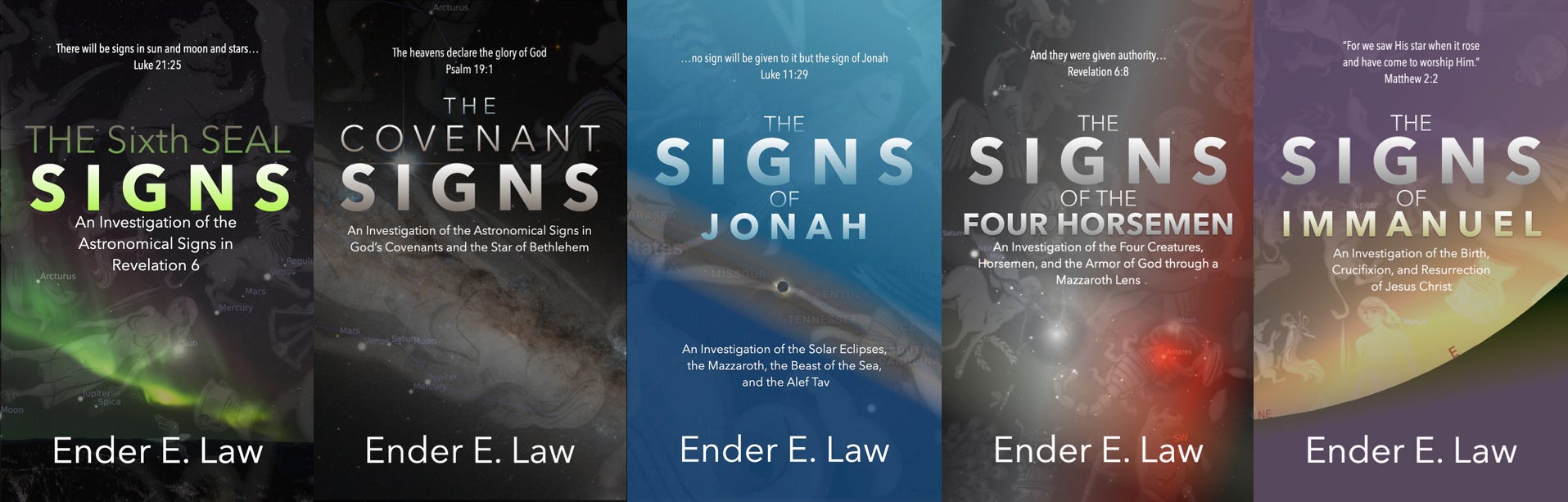
“Did these books help you in some way? If so, I would love to hear your story. Please consider sharing your thoughts on Amazon, Goodreads, or leave a comment. Thank you.”
Books and App buttons have been added to the main menu.
The Holy Bible: English Standard Version (Da 7:6). (2025). Crossway Bibles.
https://noirlab.edu/public/education/constellations/lynx/
https://www.universetoday.com/articles/lynx
https://en.wikipedia.org/wiki/Lynx_(constellation)#/media/File:Lynx_-_Prodromus_astronomiae_1690_(5590412).jpg
Strong, J. (2009). In A Concise Dictionary of the Words in the Greek Testament and The Hebrew Bible (Vol. 2, p. 79). Logos Bible Software.
Strong, J. (2009). In A Concise Dictionary of the Words in the Greek Testament and The Hebrew Bible (Vol. 2, p. 79). Logos Bible Software.
https://chicagobible.org/books/faiths-foundations/ref/104064/?chapter=122213
https://www.jewishencyclopedia.com/articles/11767-orion
https://www.biblicalcyclopedia.com/N/nimrod.html
Baez, E. (2016). Nimrod, Son of Cush. In J. D. Barry, D. Bomar, D. R. Brown, R. Klippenstein, D. Mangum, C. Sinclair Wolcott, L. Wentz, E. Ritzema, & W. Widder (Eds.), The Lexham Bible Dictionary. Lexham Press.
Horst, Peter van der. “Nimrod after the Bible.” Pages 220–32 in Essays on the Jewish World of Early Christianity. Freiburg, Switzerland: Universitätsverlag, 1990.
https://www.logos.com/grow/who-was-nimrod/
https://www.logos.com/grow/who-was-nimrod/
https://emmausroadministries.international/2020/05/20/the-real-story-in-the-stars-part-2-the-tower-of-babel/
https://www.gotquestions.org/Daniel-four-beasts.html