
Introduction
Here is the final Part 4 of Chapter 4 on the Fourth Horseman. The “Pale Green” horse and rider. The rider holds no bow, no sword, and no scales. He only has a name called “Death” and is followed by Hades.
7 When he opened the fourth seal, I heard the voice of the fourth living creature say, “Come!” 8 And I looked, and behold, a pale horse! And its rider’s name was Death, and Hades followed him.
The Holy Bible: English Standard Version (Re 6:7–8). (2016). Crossway Bibles.
As we look back on the First, Second, and Third riders, each one seems to correlate to the 2nd Temple Judaism understanding of the Heavenly Mazzaroth signs using Scripture, ancient text, mythology, and beliefs of the pagan gods during the times of John the Apostle.
This leaves us with Capricorn.
Why would Apostle John relate Capricorn to Death?
What did it mean that Hades was following him?
What piece of armor allows us to fend off Death?
The reading of Sections 4.3 to 4.5 will analyze the different correlations from the ancient Jewish tradition of a scapegoat to the story of Jesus and Caesarea Philippi.
Caesarea Phillippi
13 Now when Jesus came into the district of Caesarea Philippi, he asked his disciples, “Who do people say that the Son of Man is?” 14 And they said, “Some say John the Baptist, others say Elijah, and others Jeremiah or one of the prophets.” 15 He said to them, “But who do you say that I am?” 16 Simon Peter replied, “You are the Christ, the Son of the living God.” 17 And Jesus answered him, “Blessed are you, Simon Bar-Jonah! For flesh and blood has not revealed this to you, but my Father who is in heaven. 18 And I tell you, you are Peter, and on this rock I will build my church, and the gates of hell shall not prevail against it. 19 I will give you the keys of the kingdom of heaven, and whatever you bind on earth shall be bound in heaven, and whatever you loose on earth shall be loosed in heaven.” 20 Then he strictly charged the disciples to tell no one that he was the Christ.
The Holy Bible: English Standard Version (Mt 16:13–20). (2016). Crossway Bibles.
The story is a turning point in the ministry of Jesus. His diety is declared.
16 Simon Peter replied, “You are the Christ, the Son of the living God.”
One cannot fully understand the context of the conversations without fully understanding where they were talking. Caesarea Phillipi was one of the most evil locations in all of Israel.
Below shows the cave, or what was known as the “Gates to Hell,” and the Grotto of Pan, or ancient Banias, from the Drive Thru History video linked below. This location had generations upon generations of pagan child sacrifice to various gods, namely Baal, then Pan, and other darker rituals noted below.
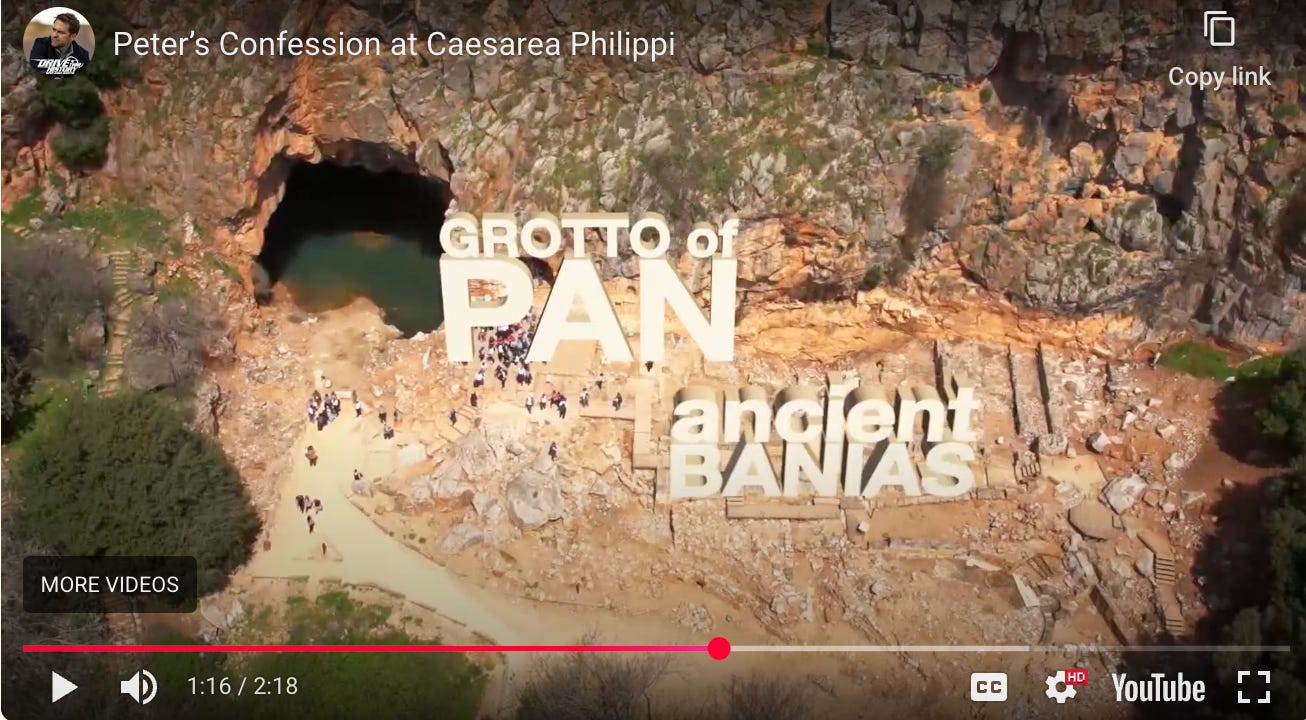
It was literally considered the “Gate of the Underworld (Hades)” by the known world at that time.
The story is also recorded in Mark,
27 And Jesus went on with his disciples to the villages of Caesarea Philippi. And on the way he asked his disciples, “Who do people say that I am?” 28 And they told him, “John the Baptist; and others say, Elijah; and others, one of the prophets.” 29 And he asked them, “But who do you say that I am?” Peter answered him, “You are the Christ.” 30 And he strictly charged them to tell no one about him.
The Holy Bible: English Standard Version (Mk 8:27–30). (2016). Crossway Bibles.
This location is only called out twice in the Bible. Both accounts refer to this turning point when Jesus is talking to his disciples in this particular location known for evil sacrifices or death, and the Gates of Hell or Hades.
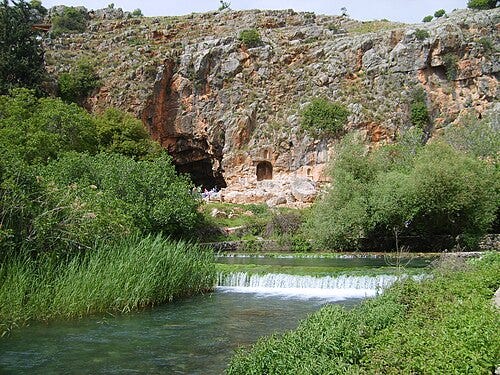
(Source: Wikipedia, Banias in the town of Caesarea Philippi with the sanctuary of Pan)1
Historical Background
The following is from Pastor Todd Fink’s video tour of Caesarea Philippi,
This place has been associated with intense false god worship and evil for many years.
Baal worship took place here during the period of the kings of Israel.
King Jeroboam set up a golden calf not far from here and commanded all the Israelites in this area to worship it.
Later, under the Greeks, it became the key place of worship to the fertility god, Pan. Pan was a half-human, half-goat-looking creature.
Then the Romans incorporated it into a place of false god worship as well.
Caesarea Philippi was originally called Panion or Panias, after the Greek god Pan. Later, it became known as Banias.
Herod the Great’s son, Philip, established it as the capital of his territory and named it Caesarea to honor the emperor of Rome. It became a large, flourishing Roman city.
It was known as Caesarea Philippi, distinguishing it from other cities with the same name.
During the time of Christ, there were 6 main areas of worship to false gods that took place here.
Herod the Great built a temple right at the mouth of this huge spring to honor Augustus Caesar.
A courtyard area for the worship of Pan.
A temple dedicated to the false god Zeus.
Court of Nemesis: Female goddess of vengeance.
An upper Tomb Temple of the Dancing Goats.
A lower Tomb Temple of the Dancing Goats.
It was a worldwide gathering place of worship to numerous false gods.
It was literally considered the “Gate of the Underworld (Hades)” by the known world at that time.
Children would be thrown alive into the entrance to the cave as a sacrifice to the god of Pan, believing this would appease the gods and bring fertility to their crops.
Some even believe that men would mate with goats in the courtyard of Pan and on the Tomb Temples in ritualistic fertility acts, believing this would help their crops. They would also have goats mating with goats in these areas.
It was a sick cesspool of evil and represented the worst Satan and sinful humanity could offer.
The disciples were very uncomfortable coming to this eerie, demonic, dark place, and no good Jew would have even considered coming here.
However, Jesus purposefully brought His disciples here to embed within their hearts the imperative truth of who He was, what the mission of His church would be, and the astounding power His church would have over evil through Him.2
The Story of Pan, Capricorn, and Typhon
The Greek god Pan is associated with the most evil location of Death. He is also remembered as the god that panicked when being followed by Typhon, the father of all monsters from Hell or Hades.
While being pursued by the monster, Pan’s shape-shift attempts resulted in Capricornus.
Could John have been referring to Capricorn when calling the “pale green” horse “Death and Hades followed him”?
Seems very plausible for someone who understood the Mazzaroth backstory and Greek Mythology.
In Summary
With this understanding, does it seem feasible that John was talking about Capricorn as Death, followed by Hades?
Why would Apostle John relate Capricorn to Death?
Capricorn refers to the god Pan, and Death refers to all the sacrifices made to the pagan god.
What does it mean that Hades was following him?
The Greek story is that Typhon from Hell or Hades sought to destroy the gods of Olympia, including Pan.
What piece of armor allows us to fend off Death?
Death is overcome with the Helmet of Salvation
In Chapter 5, we’ll summarize all 4 Horsemen and review what they did and are doing to mankind.
Review:
Linked below are the podcast posts to date for The Signs of the Four Horsemen.
Prologue, Introduction


Chapter 1 - The First Horseman


Chapter 2 - The Second Horseman


Chapter 3 - The Third Horseman


Chapter 4 - The Fourth Horseman


Additional Reading
If you like this article, please share and subscribe.
Books are available on Amazon (in Kindle and Paperback Formats).
Barnes & Noble (has 2 books currently)
Bookshop.org (has 2 books currently)

Ephesians 6:10 is a reader-supported publication. To receive new posts and support my work, consider becoming a free or paid subscriber.
Subscribe or follow for weekly updates.
God Bless!
https://en.wikipedia.org/wiki/Banias
Fink, T. (2024). [Youtube] Caesarea Philippi: Peter’s Confession of Christ & the Gates of Hell! Who Is Jesus & His Church? https://www.youtube.com/watch?v=sIP9WtDBv4I


