
Review Parts 1 to 10
Research on The First to Third Beasts of Daniel Chapter 7:
Introduction
In Daniel 7:6
7 After this I saw in the night visions, and behold, a fourth beast, terrifying and dreadful and exceedingly strong. It had great iron teeth; it devoured and broke in pieces and stamped what was left with its feet. It was different from all the beasts that were before it, and it had ten horns. Daniel 7:7, ESV1
The terrifying fourth beast, with iron teeth and powerful feet, is “like a dragon”. A dragon with ten horns. In future analysis, the dragon will also be compared to the Revelation 12 dragon with ten horns, which is clearly identified:
9 And the great dragon was thrown down, that ancient serpent, who is called the devil and Satan, the deceiver of the whole world… Revelation 12:9, ESV2
The traditional historical interpretation of this fourth beast is the Greek or Roman Empire. The beasts and the ten horns are interpreted as nations. Later, we will look at the little horn. But again, Chapter 7 does not specifically name the nations, leaving that to interpretation.
The following questions will be explored in this article,
Are there signs that correlate to this beast?
Did Babylon have mythological beasts similar to these?
What could this all mean?
Hypothesis: Daniel’s vision of a fourth beast could be related to a dragon, which mirrors the second great Sign in Heaven.
Out of the Sea: A Night Vision
Let’s review Daniel,
3 And four great beasts came up out of the sea, different from one another. Daniel 7:3, ESV
The great beasts “came up out of the sea”, a cosmic sea, a belief that was dominant during Daniel’s time in Babylon. The cosmic ocean was held back by the firmament. The stars and luminaries are in the firmament, which forms the constellations.
7 After this I saw in the night visions, and behold, a fourth beast… Daniel 7:7, ESV
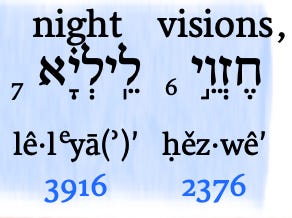
What are “night visions”? It can be further defined in the original Aramaic. “Night” is Strong’s Concordance 3916, a Chaldaism or idiom, lay-leh-yaw´, corresponding to 3915, which can figuratively mean night or midnight.3
The second word shown is “vision”, which is Strong’s Concordance 2376, another idiom, khay´-zev, from 2370, denoting sight, look, vision, to gaze, or to dream.4
Thus, together, Daniel's wordplay implies he is seeing these beasts at night, gazing up at midnight and dreaming. The shapes that he sees can then be correlated to the connecting of stars in the Heavenly firmament, which form the Mazzaroth beasts.
If we continue to follow the previous research on the Mazzaroth constellations, where the first beast is the lion, the second beast is the Great Bear, the third beast is a chimera, multi-headed Cerberus with the winged constellations, and the Babylonian Panther, then what constellations describe something like a dragon or serpent of old?
There are three candidates in the Heavens: Draco the dragon, Hydra the crooked serpent, and Serpens, being wrestled by Ophiuchus, aka Asclepius.
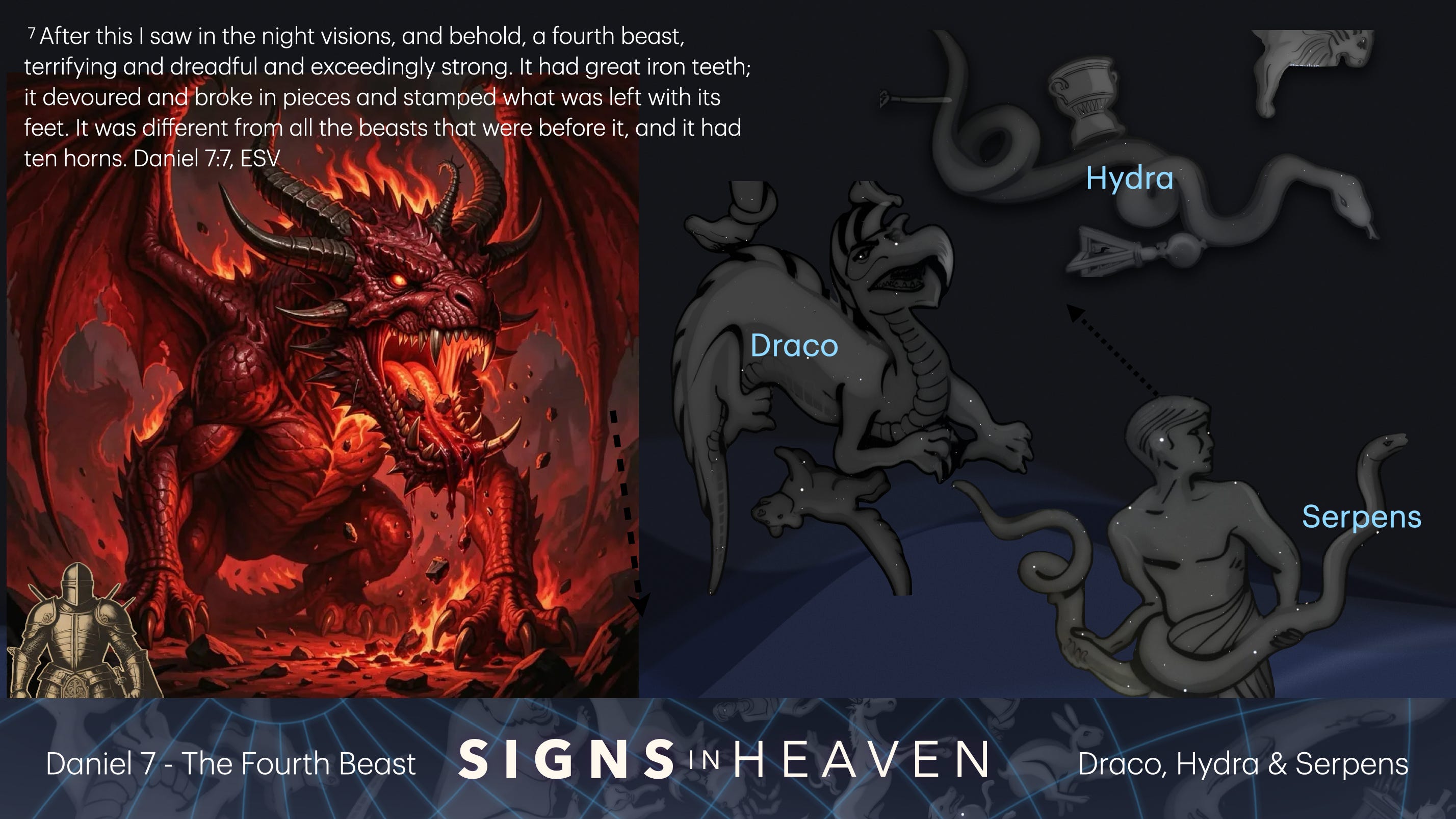
(source: Night Cafe dragon, Stellarium)
Let’s explore what Daniel would have been familiar with from a Babylonian context.
Ishtar Gate
The Biblical narrative says Daniel lived in Babylon throughout King Nebuchadnezzar II’s reign. Taken as a youth from Jerusalem during the 605 BC siege of Judah, he was brought to the capital. Because of his intelligence, he was trained in court customs and rose to prominence after interpreting the king’s prophetic dreams (Daniel 1). He lived in the imperial court for more than 70 years and regularly walked through the newly built Ishtar Gate.5
In the early twentieth century, German archaeologists excavated the gate fragments from the ruins of Babylon in modern Iraq. They shipped the glazed bricks to Berlin and meticulously reassembled them.6
The gate was designed and decorated with alternating images of mušḫuššu (dragons), aurochs (bulls), and lions, symbolizing Marduk, Adad, and Ishtar, respectively.7
These animals are symbolic representations of certain deities:
Lions are often associated with Ishtar, who was a goddess of fertility, love, war, and sex,
Bulls are associated with Adad, who was a god of weather, and
Dragons are associated with Marduk. Who was the chief or national god of Babylon, analogous to Zeus for the Greeks and Jupiter for the Romans?8
As noted earlier, the fiery-red dragon of Revelation 12 was identified by the Apostle John as Satan, the serpent of old. Marduk, Zeus, and Jupiter are each the national gods of Babylon, Greece, and Rome, respectively, and were often equated by ancient believers in YHWH as the leading pagan demons set out to destroy the images of the one true God. Thus, they can all be equated to Satan.
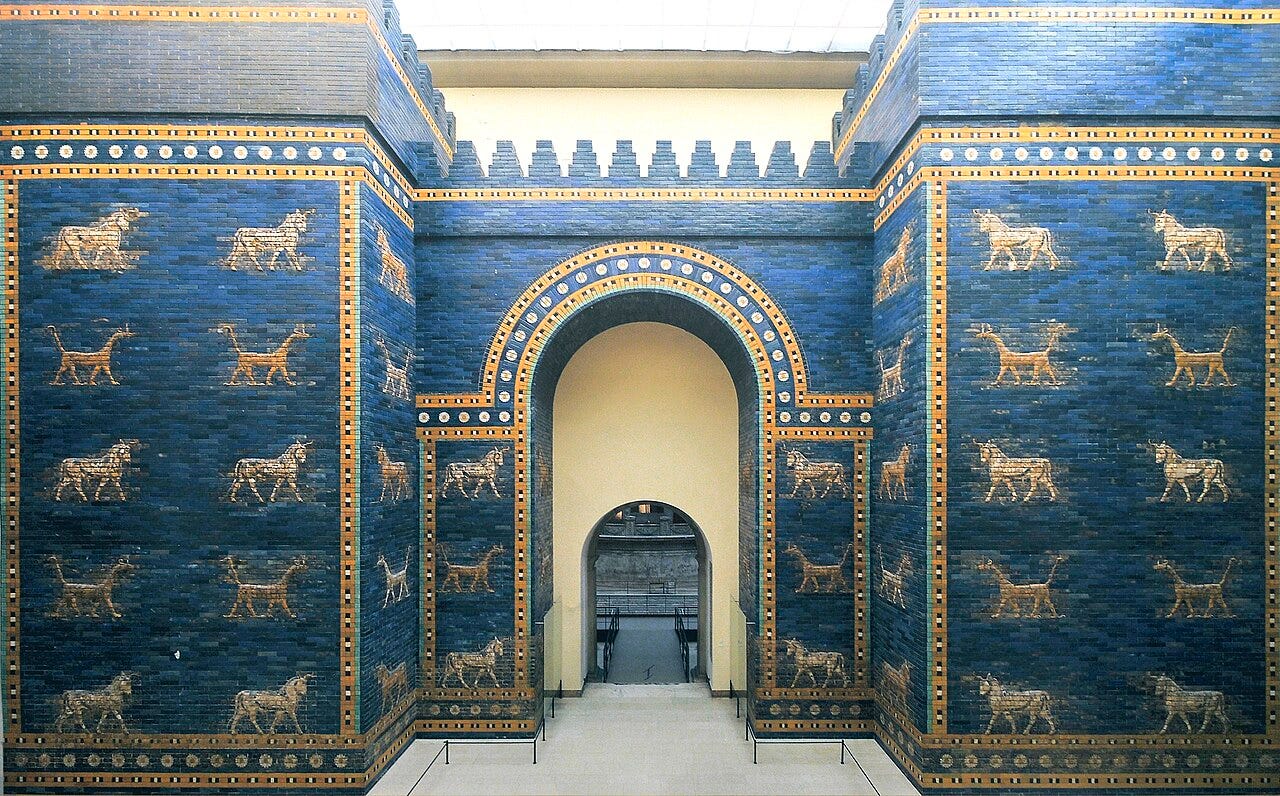
(source: Ishtar Gate, Pergamon Museum, Berlin. CC BY-SA 4.0)9
Pergamum (Latin) or Pergamon (Greek)
The Ishtar Gate is reconstructed in the Pergamon Museum. In the same museum is housed the throne of Zeus, also referenced in the Book of Revelation by the Apostle John and known as Satan’s throne.
12 “And to the angel of the church in Pergamum write: ‘The words of him who has the sharp two-edged sword.
13 “I know where you dwell, where Satan’s throne is. Yet you hold fast my name, and you did not deny my faith even in the days of Antipas my faithful witness, who was killed among you, where Satan dwells.10
Revelation 2:12–13, ESV
Apostle Paul appointed Bishop Antipas over the church in Pergamum, where he preached, cast out demons, and refused to comply with the Roman god-emperor, which drove the pagan worshipers to kill Antipas by roasting him on a bronze ox on the steps of the Pergamum altar, the altar to Zeus. Thus, those who followed the commands of Jesus saw Zeus as Satan, and Pergamum was where Satan dwells.
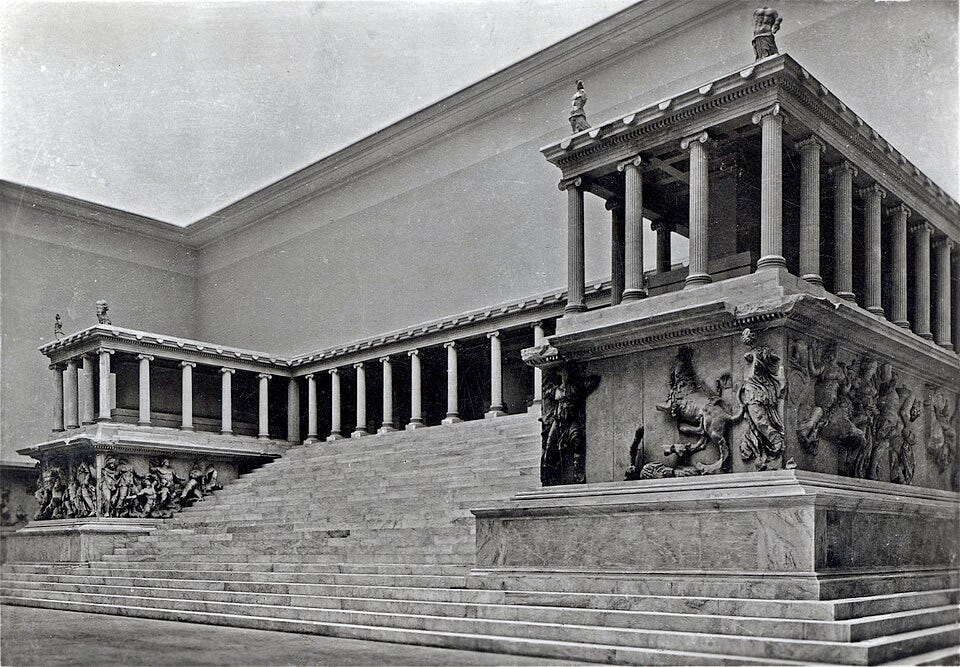
(source: Pergamon Altar, Pergamon Museum, from 2nd century BC, Turkey)
Both the Ishtar Gate and the Pergamon Altar are recognized today as ancient wonders of the world. The gate and altar to worship Marduk and Zeus, respectively, now reside in the same museum, the same cosmic geography, bringing together the 5th and 2nd centuries BC for all to see.
Marduk and Zeus are gods from Babylon and Greece, respectively, who were both seen as Satan or Princes of the Earth. Those who worshipped the true God of Heaven and Earth, who did not bow down and worship these pagan demonic gods, were tortured and killed for not complying with Satan himself. Similarly, Daniel refused to comply and worship Marduk. These same demonic entities roam the Earth today, known as the dragon.
4 His tail swept down a third of the stars of heaven and cast them to the earth. And the dragon stood before the woman who was about to give birth, so that when she bore her child he might devour it. Revelation 12:4, ESV11
9 And the great dragon was thrown down, that ancient serpent, who is called the devil and Satan, the deceiver of the whole world—he was thrown down to the earth, and his angels were thrown down with him. Revelation 12:9, ESV12
Let’s look closer at the dragon on the Ishtar Gate.
A Hybrid Dragon - Divine Companion of Marduk
The creature that patrolled ancient Babylon’s walls was the mušḫuššu, meaning “furious snake.” This dragon combined four animals.
It had a slender, scaly body and a long tail tipped with a scorpion stinger.
Its curved neck carried the head of a horned viper with a forked tongue.
It moved on the front paws of a lion and the hind claws of an eagle.
The design blended the ancient world’s most feared predators.
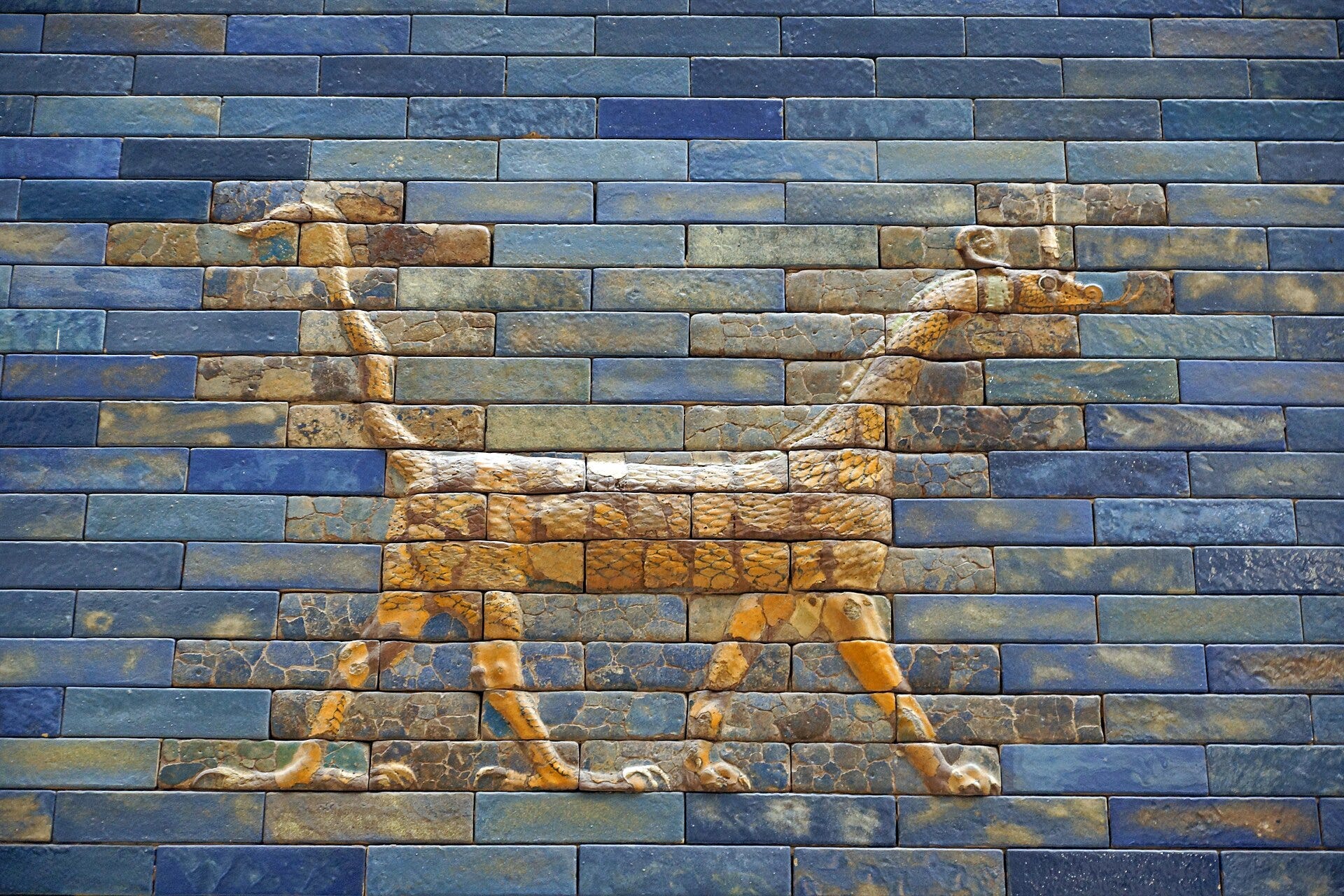
(source: mušḫuššu, Pergamon Museum, Ishtar Gate, CC BY 2.0)13
To the Babylonians, the mušḫuššu was a sacred guardian rather than a terrifying monster. It served as the divine companion to Marduk, the chief god of the Babylonian pantheon.14
Marduk represented creation, water, and magic, and supposedly defeated chaos to bring order to the universe. Displaying his dragon on the gates proved that the king ruled with divine approval. A pagan god-demon dragon approved of the pagan king.
King Nebuchadnezzar II built the Ishtar Gate around 575 BC during Babylon’s grand revitalization.15 After defeating the Assyrians, the Neo-Babylonian Empire used massive architecture to display military dominance. The gate served as the main city entrance and the starting point for the festive Processional Way. By covering the structure in expensive, vibrant blue glazed bricks, the king signaled both imperial power and divine favor to all visitors.16
The Ishtar Gate mixed religious art with psychological warfare.17 The defensive structure used aesthetics to inspire political submission and religious awe. As travelers or captives, as in the case of young Daniel, walked down the narrow Processional Way, the brilliant blue glaze would reflect the sunlight, reminding the foreigners that they must comply. The king demanded their obedience and worship. The lions, bulls, and dragons would appear to step out from the walls, warning visitors that Babylon was protected by living gods and an unstoppable king.
Did the Babylonians also worship the hybrid demonic dragon in their Heavenly planisphere?
Hydra and Bašmu
The hybrid dragon mušḫuššu is not listed by name as a constellation in the Babylonian astronomical compendium, the MUL.APIN, the oldest astronomy clay tablets. Instead, a different mythological serpent constellation, known as Bašmu, corresponds to the modern Hydra. The Bašmu shares visual and iconographic similarities with the mušḫuššu but remains anatomically distinct, as the Bašmu is depicted as a serpent without visible hind feet.
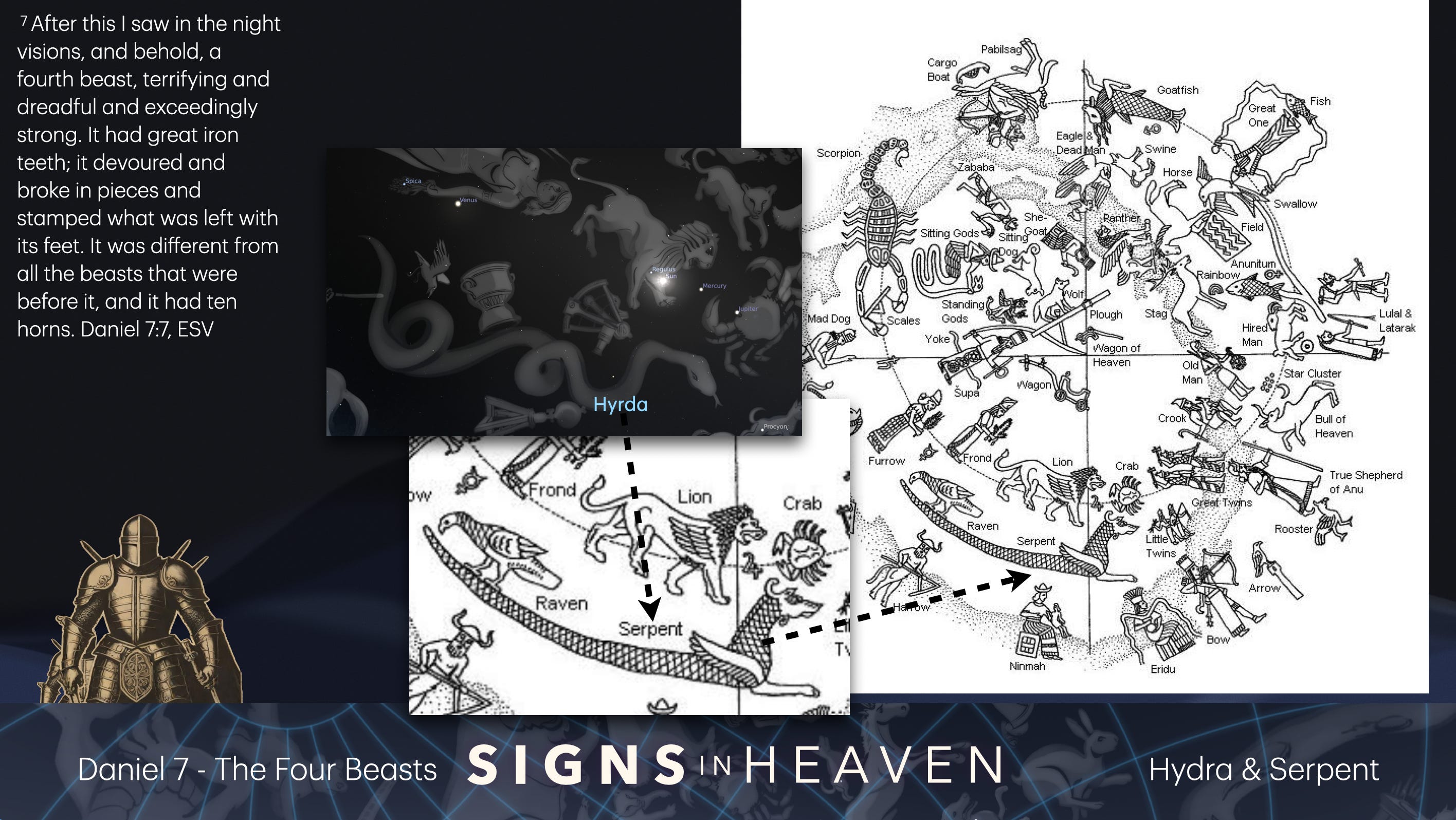
Hydra, the crooked serpent, is a strong candidate for the fourth beast and is even noted in the oldest book of the Bible, Job.
Hydra, Draco, and Serpens
In 1915, The International Standard Bible Encyclopedia states,
1. Nāḥāsh, the “Crooked Serpent”
The direct references to these old constellation-forms in Scripture are not numerous. One of the clearest is in Job 26:13, where “formed the crooked serpent” (AV) is used as the correlative of “garnished the heavens”; the great constellation of the writhing Dragon, placed at the crown of the heavens, being used, metaphorically, as an expression for all the constellations of the sky. For by its folds it encircles both the poles, that of the equator and that of the ecliptic.18
Thus, there are three candidates for the fourth beast, or three depictions of evil.
In Closing
Are there signs that correlate to this beast?
Yes, Hydra, Serpens, and/or Draco
Did Babylon have mythological beasts similar to these?
Yes, Bašmu shares visual and iconographic similarities with the mušḫuššu
Bašmu is Hydra
The Babylonian national god Marduk is associated with its companion, the mušḫuššu
What could this all mean?
Understand that the fourth beast is the dragon, the serpent of old, Satan, which shows that the Prince of the Earth is actively influencing tyrannical nations. Understand that the constellations of Hydra, Serpens, and Draco were formed from stars named by God during Creation, crooked serpents in the heavens, reminders to stay vigilant and alert, revealing that this is a spiritual war in Heaven as it is on Earth. The storyboard shows that we battle evil in many forms, and the Signs in Heaven are there to warn us, as in Daniel’s night vision.
More to come on the fourth beast.
Future Note: A “Devil Comet” was discovered on June 10th, 2020, coming from this region in the Heavens.
Let’s continue with the fourth and final beast in Daniel 7.
“Did these books help you in some way? If so, I would love to hear your story. Please consider sharing your thoughts on Amazon, Goodreads, or by leaving a comment. Thank you.”
Books and App buttons have been added to the main menu.
The Holy Bible: English Standard Version (Da 7:7). (2025). Crossway Bibles.
The Holy Bible: English Standard Version (Re 12:9). (2025). Crossway Bibles.
Strong, J. (2009). In A Concise Dictionary of the Words in the Greek Testament and The Hebrew Bible (Vol. 2, p. 58). Logos Bible Software.
Strong, J. (2009). In A Concise Dictionary of the Words in the Greek Testament and The Hebrew Bible (Vol. 2, p. 38). Logos Bible Software.
Jeremiah D. Agents of Babylon: What the Prophecies of Daniel Tell Us about the End of Days. Tyndale House Publishers, 2015.
Museum Island Berlin. Vorderasiatisches Museum (Museum of the Ancient Near East). Museum Island Berlin Visitor Guide. 2026. Accessed August 14, 2026. museumislandberlin.com
Kleiner, Fred (2005). Gardner’s Art Through the Ages. Belmont, CA: Thompson Learning, Inc. p. 49. ISBN 978-0-15-505090-7.
García, B. (2013). Ishtar Gate. World History Encyclopedia. https://www.worldhistory.org/Ishtar_Gate/
https://en.wikipedia.org/wiki/Ishtar_Gate#/media/File:Berl%C3%ADn,_Museo_de_P%C3%A9rgamo_05.jpg
The Holy Bible: English Standard Version (Re 2:12–13). (2025). Crossway Bibles.
The Holy Bible: English Standard Version (Re 12:4). (2025). Crossway Bibles.
The Holy Bible: English Standard Version (Re 12:9). (2025). Crossway Bibles.
https://en.wikipedia.org/wiki/Mu%C5%A1%E1%B8%ABu%C5%A1%C5%A1u#/media/File:Sirrush.jpg
Wilson RD. Studies in the Book of Daniel: A Bible Commentary on the History, Captivity and Language of Prophet Daniel. Illustrated ed. Ariel Publishing; 2025.
Sack R. Images of Nebuchadnezzar: The Emergence of a Legend. 2nd ed. Susquehanna University Press; 2003.
Sack R. Images of Nebuchadnezzar: The Emergence of a Legend. 2nd ed. Susquehanna University Press; 2003.
Sack R. Images of Nebuchadnezzar: The Emergence of a Legend. 2nd ed. Susquehanna University Press; 2003.