
Recap
Previous articles:
Parts 1 to 6 can be reviewed on this page.
This is Part 7: Third Beast continuation, which is a hypothesis that aligns Daniel 7 with Revelation 6 and the First Horseman.
Introduction
In Daniel Chapter 7, the Lion and the Bear have been associated celestially with Leo the Lion and Ursa Major, the Great Bear. Traditional interpretations have also associated the four beasts with historical kingdoms such as Babylon, Media-Persia, Greece, and Rome, respectively. However, using the celestial constellations, the first two beasts have also been correlated to the 2017 Solar Eclipse near the heart of the lion and the Comet of 2020 with three tails in the mouth of the bear. Let’s take a look at the third beast.
6 After this I looked, and behold, another, like a leopard, with four wings of a bird on its back. And the beast had four heads, and dominion was given to it.
Daniel 7:6, ESV1[emphasis added]
The following questions will be explored,
How does the third beast correlate to Babylonian Mythology?
Is there a beast “like a leopard” in Babylonian star lore?
How does Nimrod relate to Revelation?
Hypothesis: Daniel’s vision of a third beast, like a leopard, can be correlated to a demonic Panther in Babylonian star lore, a plague, and a spiritual warfare Sign in Heaven.
In the last article, we dove into the wordplay of “leopard” denoting panther and Nimrod himself. Let’s look beyond wordplay and investigate Babylonian mythology and their pantheon of gods.
Anzu and Ninurta
In the British Museum is a wall carving found in Nineveh dating to the Neo-Assyrian period, c. 860 BC, which predates Daniel by more than a couple of centuries. The gypsum wall panel depicts a monster (left) called Anzû, part panther, part griffin, battling Ninurta (right).
Anzû was a force of chaos, storms, and a demonic entity that battled the gods. In Babylonian myths, Anzû was depicted as a massive bird - also as an eagle with a lion’s head. Anzû could also breathe fire and water. In one legend, it stole the Tablets of Destiny to gain cosmic authority.2
Ninurta has been associated with Nimrod; both were hunters and mighty men. The god Ninurta has four wings and two trident thunderbolts. Ninurta is the chief god of the city of Nimrud.3
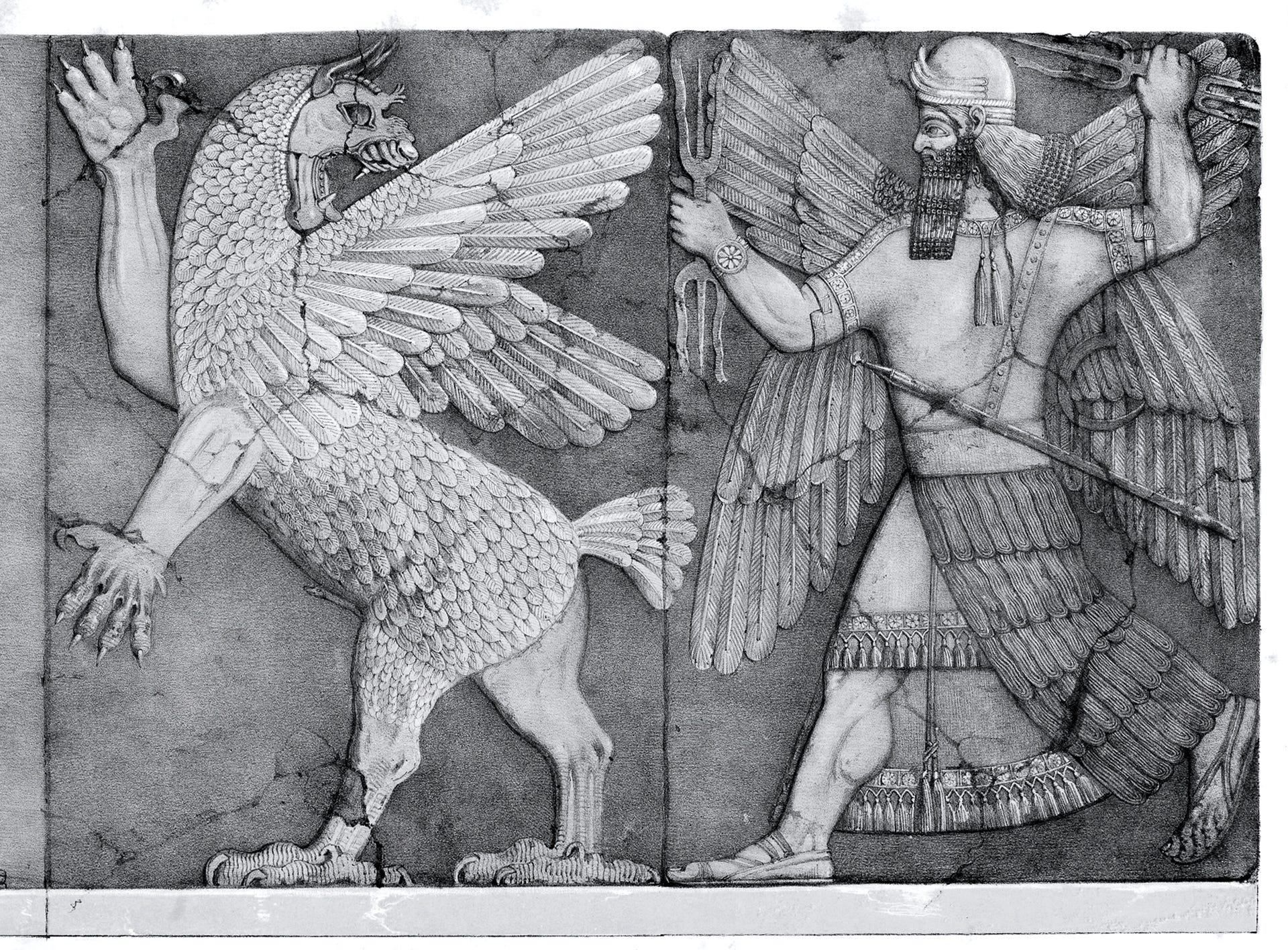
(source: public domain, wikipedia, image depicts Ninurta (on the right) battling Anzû)4
The Anzu had two wings of a griffin and was not pictured with four wings; however, Ninurta was pictured with four wings: two raised wings and two lowered. Was Anzu the third beast from Daniel’s vision? Possibly, but there is another god with wings and a body of a lion or panther.
Nergal
In 2nd Kings, Nergal is mentioned as one of the pagan gods,
29 But every nation still made gods of its own and put them in the shrines of the high places that the Samaritans had made, every nation in the cities in which they lived. 30 The men of Babylon made Succoth-benoth,
the men of Cuth [northern Babylon] made Nergal,
the men of Hamath made Ashima, 31 and the Avvites made Nibhaz and Tartak; and the Sepharvites burned their children in the fire to Adrammelech and Anammelech, the gods of Sepharvaim.
2nd Kings 17:29-31, ESV
Cuth (כּוּת), a Mesopotamian city in northern Babylonia, also known as Kutha, is located about 25 miles northeast of Babylon. Archaeological surveys reveal a center devoted to the worship of Nergal.5. Let’s also reference what Paul writes to the Corinthians,
20 No, I imply that what pagans sacrifice they offer to demons and not to God. I do not want you to be participants with demons. 1 Corinthians 10:20, ESV6
Nergal is described in the McClintock and Strong Biblical Cyclopedia online,
[Hebrew] Nergal', נֵרגִל… one of the chief Assyrian and Babylonian deities (2Ki 17:30), seems to have corresponded closely to the classical Mars. He was of Babylonian origin, and various derivations of the name have been suggested…
"His monumental titles are — 'the storm-ruler,' 'the king of battle,' 'the champion of the gods,' 'the male principle' (or 'the strong begetter'), 'the tutelar god of Babylonia,' and 'the god of the chase.' Of this last he is the god pre-eminently; another deity, Nin, disputing with him the presidency over war and battles. It is conjectured that he may represent the deified Nimrod the mighty hunter before the Lord from whom the kings both of Babylon and Nineveh were likely to claim descent.7
After Nimrod's death, some believe that later generations began worshipping Nimrod under the name and persona of Nergal. Nergal may represent Nimrod or have the spirit of Nimrod.8 In previous research, Nimrod was associated with a giant, and thus he would be a disembodied spirit of the Nephilim. The Book of Enoch describes this in Chapter 15,
8 And now, the giants, who are produced from the spirits and flesh, shall be called evil spirits upon the earth, and on the earth shall be their dwelling. 9 Evil spirits have proceeded from their bodies; because they are born from men, and from the holy Watchers is their beginning and primal origin; they shall be evil spirits on earth, and evil spirits shall they be called.
Enoch 15:8–99
Nergal is sometimes sculpted with the head and torso of a man and the body of a large big cat. Nergal is a winged centaur-like creature. Unlike a centaur, half man and half horse, Nergal is half man and half large cat.
The Greeks have a similar centaur god, Chiron, also spelled Keiron. In Greek Mythology, the wise centaur is trained by Apollo, the god who brings forth plagues with his arrows, and Chiron then trains Asclepius, the god of medicine, in the use of snake venom. In The Signs of the Four Horsemen, research identifies Chiron as the constellation Sagittarius, the First Horseman, with a bow and crown to conquer. Sagittarius has a star called Nunki, the Prince of the Earth.
Note: These supernatural gods were depicted as winged hybrids. The origins of these demonic gods may have been the spirits of antediluvian genetic mutations, also referenced in the Book of Enoch, the Book of Jasher, and the Book of Jubilees. This may be unpacked further in the book and future articles.
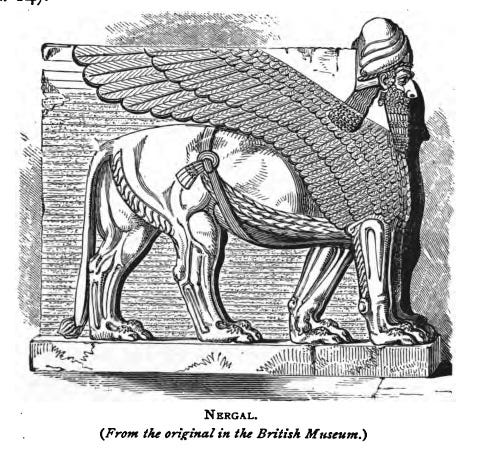
Yaǧmur Heffron, author of Ancient Mesopotamian Gods and Goddesses, describes Nergal, a Mesopotamian god who inflicts death through pestilence, plague, and warfare. He is also known as Lord of the Underworld. Nergal’s warlike qualities are similar to warrior gods such as Ninurta. Nergal also had a supernatural dimension by inflicting disease, often attributed to demonic forces. Nergal controls a variety of demons and evil forces as Satan does.10
Note: Bridging Revelation Chapter 6 and Daniel Chapter 7 with a Sign in Heaven: This research on the god Nergal brings forth a whole new dimension with the March 11th, 2020 spiritual warfare sign involving Saturn, Jupiter, and Mars in Sagittarius. March 11th, 2020 is a foreboding date, the very day the World Health Organization (WHO) declared a plague of fear on mankind.
Sagittarius aka Pabilsag
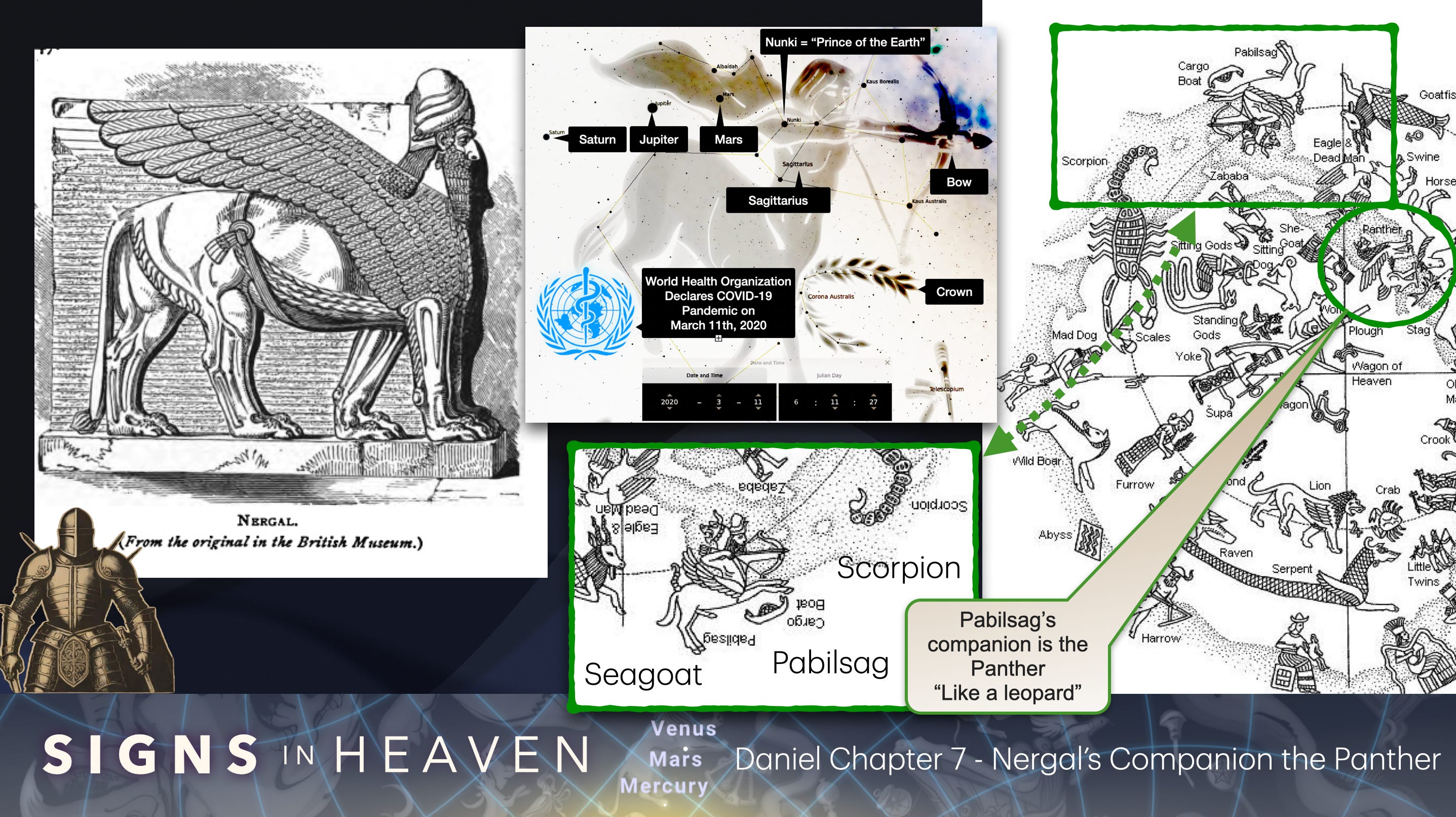
(source: British Museum, Stellarium, The Signs of the Four Horsemen, Gavin White11)
Furthermore, in Babylonian star lore, Nergal is Pabilsag, or Sagittarius, but it is given wings and a venomous stinger tail similar to Scorpius.12 In the diagram above, Pabilsag is shown between the Seagoat and Scorpion, which are correlated to the Fourth and Second Horsemen, respectively (See The Signs of the Four Horsemen for detailed celestial interpretations of all Four Horsemen).
Gavin White writes,
Pabilsag (Sagittarius) Pabilsag is the direct forerunner to the centaur-archer that we know today as Sagittarius. His name can be translated as the ‘Chief Ancestor’ or ‘Forefather’, and he can be best compared to the Wild Hunter of western folklore who guides the souls of the dead to the afterlife over the course of the winter months.13
Nergal, the god of death and pestilence, also has a companion constellation in the Heavens, the Panther, which is circled in the diagram. Both constellations are situated along the Milky Way.
Note: Milky Way’s Great Rift Significance - In the next article, the Great Rift will be analyzed in relation to the constellations Cygnus and a lesser-known Cerberus of the Underworld.
The MUL.APIN, the oldest astronomy book in recorded history, captures Babylonian star lore and the Panther. Note the diagram (see green rectangle), which is in the top-right quadrant of the planisphere above the “Wagon of Heaven”, the Little Dipper, Ursa Minor. The polestar is at the center of the planisphere. In the top-right quadrant is a winged Panther. Is this Anzu, or merely a coincidence?
Panther Like A Leopard
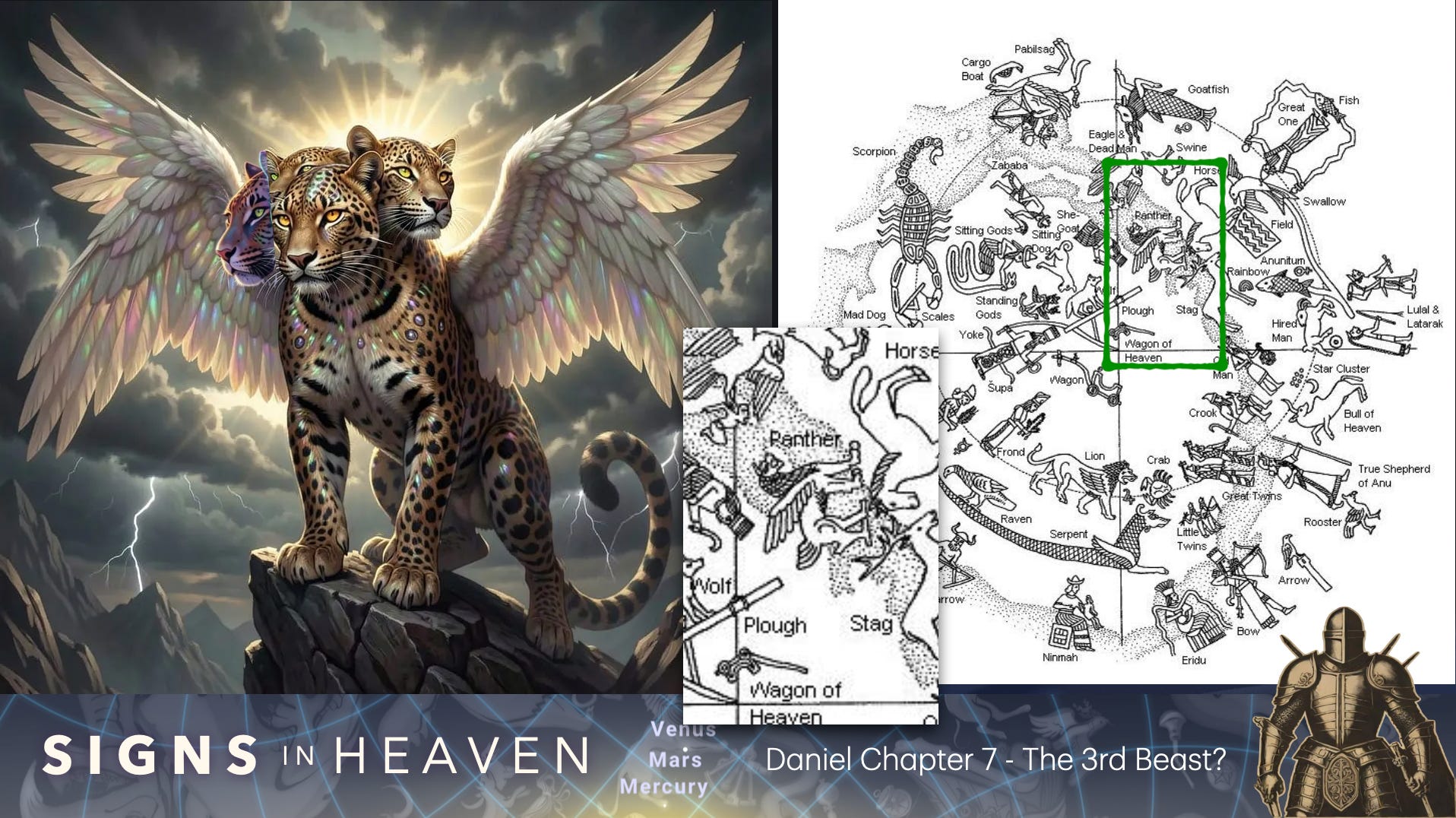
(source: Night Cafe, Gavin White Babylonian Planisphere14).
The Babylonian planisphere documented by Gavin White includes a Panther, which is also like a leopard, nimru. It has a pair of wings, and the rear paws are actually bird claws, like a griffin.
All Skies Encyclopedia describes this Panther constellation,
A Mesopotamian constellation in the region of Cygnus and Cepheus. The Sumerian term UD.KA.DU8.A (𒌓𒅗𒂃𒀀) is a compound which is translated into Akkadian literally meaning "the demon with the gaping mouth," which is translated into Akkadian as u4-mu na-ᵓ-ri, 'raging storm,' in the star-list VR 46 1: 41 (and dupl.). In lists of animals, UD.KA.DU8.A is equated with the Akkadian nimru, "panther", suggesting that the asterism is a panther-demon, perhaps a panther griffin.15
The Panther appears to be related to Anzu; Gavin White also relates the beast to Nergal.
Panther (Cygnus & part of Cepheus) Like Pabilsag, the Eagle and Dead Man, which all rise at the time of the winter solstice, the Panther is closely associated with the realm of the dead and the afterlife.
It [the Panther constellation] is the sacred beast of Nergal, the Babylonian lord of the dead, and it has probably been set among the winter-time stars to guard the entrance to the underworld. A memory of the Panther may well live on in the guise of Cerberus, the three-headed hound that guarded the entrance to the Greek underworld.
In the Babylonian Heavens, the Panther is the sacred beast of Nergal.
Note: More to come on Cerberus and Cygnus.
In Closing
What have we learned so far? The interpretation of Daniel 7:5 falls into place by studying the c. 500 BC worldview of Daniel’s Babylonian contemporaries along with the MUL.APIN, the earliest surviving comprehensive Babylonian astronomical compendium16, and Gavin White’s star lore research, combined with Babylonian and Greek Mythology.17
How does the third beast correlate to Babylonian Mythology?
The third beast is like a nimrā, a leopard, panther, jaguar, or tiger
Nergal is the god that inflicts death through plagues, and its sacred beast is the Panther constellation drawn like Anzu.
Nergal is half man, half “panther” with wings.
Nergal has been associated with Nimrod, who is the leopard tamer
Anzu is a panther-griffin demon of chaos and storms.
Nimrod and Nergal are both associated in mythology. Nergal was worshipped as the spirit of Nimrod.
The third beast is associated through wordplay to Nimrod
Nergal and the Panther are winged. Four wings are carved onto Ninurta. All associated with the spirit of Nimrod.
Is there a beast “like a leopard” in Babylonian star lore?
The winged Panther is the sacred beast of Nergal and can be found in the MUL.APIN as well as Gavin White’s Babylonian planisphere.
Gavin White has drawn the Panther to look like the panther-griffin demon, possibly Anzu.
How does Nimrod relate to Revelation?
Nergal is Sagittarius, Pabilsag, with a bow and crown and related to Revelation 6:2
Nergal also has a scorpion tail, thus carrying deadly venom.
March 11th, 2020, there was a Spiritual Warfare sign in Sagittarius on the day the WHO released a plague of fear (Revelation 6:2), which involved a deadly bioweapon.
Saturn, Jupiter, and Mars aligned with Nunki, the Prince of the Earth, on the day the fiery-red dragon, the serpent-of-old, Satan gave authority to the Beast of the Sea to begin the ride of the Four Horsemen and bring on death. At this time, the third beast of Daniel 7, through the spirit of Nimrod, Nergal, and Anzu, inflicted a plague of chaos upon mankind.
2 And I looked, and behold, a white horse! And its rider had a bow, and a crown was given to him, and he came out conquering, and to conquer.
Revelation 6:2, ESV18
Prayer: Lord Jesus, through your power and strength, we rebuke these demons.
“Did these books help you in some way? If so, I would love to hear your story. Please consider sharing your thoughts on Amazon, Goodreads, or leave a comment. Thank you.”
Books and App buttons have been added to the main menu.
The Holy Bible: English Standard Version (Da 7:6). (2025). Crossway Bibles.
https://en.wikipedia.org/wiki/Anz%C3%BB
https://www.britishmuseum.org/collection/object/W_1851-0902-501?selectedImageId=428207001
https://en.wikipedia.org/wiki/Anz%C3%BB#/media/File:Chaos_Monster_and_Sun_God.png
https://biblehub.com/hebrew/3575.htm
The Holy Bible: English Standard Version (1 Co 10:20). (2025). Crossway Bibles.
https://www.biblicalcyclopedia.com/N/nergal.html
https://www.biblicalcyclopedia.com/N/nergal.html
Charles, R. H., & Oesterley, W. O. E. (1917). The Book of Enoch (Enoch 15:8–9). Society for Promoting Christian Knowledge.
Yaǧmur Heffron, ‘Nergal (god)’, Ancient Mesopotamian Gods and Goddesses, Oracc and the UK Higher Education Academy, 2024 [http://oracc.museum.upenn.edu/amgg/Listofdeities/Nergal/]
White, G. (2007). Babylonian Star-lore, An Illustrated Guide to the Star-lore and Constellations of Ancient Babylonia. https://solariapublications.com/2011/10/25/map-2-full-reconstruction-of-the-babylonian-star-map/
https://noirlab.edu/public/education/constellations/sagittarius/
https://solariapublications.com/2011/10/25/a-brief-guide-to-the-babylonian-constellations/
White, G. (2007). Babylonian Star-lore, An Illustrated Guide to the Star-lore and Constellations of Ancient Babylonia. https://solariapublications.com/2011/10/25/map-2-full-reconstruction-of-the-babylonian-star-map/
https://ase.exopla.net/index.php/UD.KA.DU8.A
https://peachv.org/images/MuslimGeo/BabyAstroMulApinHunger.pdf
White, G. (2007). Babylonian Star-lore, An Illustrated Guide to the Star-lore and Constellations of Ancient Babylonia. https://solariapublications.com/2011/10/25/map-2-full-reconstruction-of-the-babylonian-star-map/
The Holy Bible: English Standard Version (Re 6:2). (2025). Crossway Bibles.