
The Four-Headed Beast Is Given Dominion To Take Control
Part 10: Daniel Chapter 7 - Third Beast Analysis - Underworld and Cerberus
Dear Readers,
Please consider leaving a rating or comment on Goodreads or Amazon to help new readers find this research on Bible prophecy. It may be just what someone needs to resolve doubts and change their life in their walk with Jesus, the God of Heaven and Earth. This research has been a paradigm shift for me, helping my faith journey.
Recap
Previous articles:
Parts 1 to 9 - First to Third Beasts of Daniel Chapter 7
Introduction
Hypothesis: Daniel’s vision of a multi-headed third beast is a supernatural guardian of the Underworld, like Cerberus, that was given dominion over the Earth for a time starting in 2020.
In Daniel 7:6
6 After this I looked, and behold, another, like a leopard, with four wings of a bird on its back. And the beast had four heads, and dominion was given to it.
Daniel 7:6, ESV1[emphasis added]
The following questions will be explored,
How is Cerberus related to the Panther in the Summer Triangle?
How many heads does Cerberus have?
What is the correlated interpretation of the third beast?
Review
In this article, we will conclude our analysis of the third beast. The picture being painted is that of Daniel’s vision described in Chapter 7: cosmic beasts marked by astronomical signs, given dominion over the Earth.
To review, we have been unpacking the multiple layers of the third beast and how the leopard can be correlated to Nimrod, as well as the Babylonian winged Panther, Anzu, the companion beast of Nergal, aka Palbisag, known as Sagittarius, the First Horseman of Revelation 6, who brings death and plague.
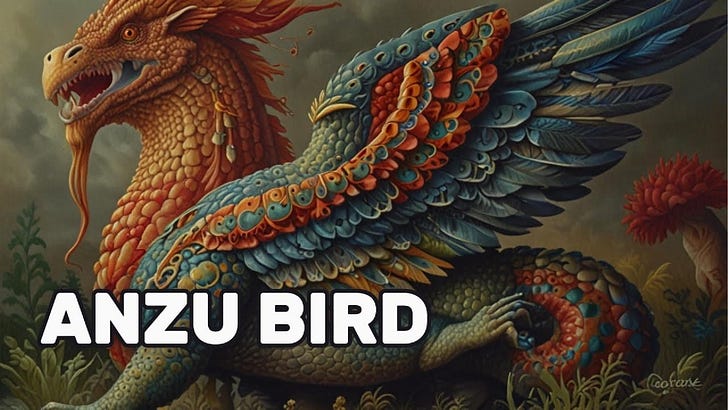
The third beast has four wings, which have been correlated to the Babylonian god Nirnurta, where the four wings represent a supernatural being with cosmic powers.
However, Why Four Heads?
Is it tied to the traditional interpretation that the third beast represents Alexander the Great and the four heads represent the four kingdoms formed upon Alexander’s death? Or some scholars equate the third beast with Persia and the fourth beast with Alexander, the Greek empire.
Unfortunately, in the context of the third beast, there is no direct interpretation of the four heads spelled out in Chapter 7.
Some scholars link the four heads with Daniel 8:22 and the four horns, which are explicitly interpreted as nations. However, I am not sure the horns can be mapped to the four heads of the third beast in Chapter 7.
Daniel 7:17-18 states that each beast is a king, but there is no interpretation for the heads, and the kings are not named in this vision.
17 ‘These four great beasts are four kings who shall arise out of the earth. 18 But the saints of the Most High shall receive the kingdom and possess the kingdom forever, forever and ever.’
Da 7:17–18, ESV2
What if the four heads of this third king describe a cosmic beast unleashed upon the Earth and given dominion? Could this be a beast that is well known in Greek Mythology? The question posed here is whether the king is a flesh-and-blood monarch or a supernatural spirit. Or an earthly governing body being influenced or controlled by a beast with four heads?
Paul writes that the worship of pagan gods is demonic (1 Corinthians 10:20). In the Old Testament, the same is spelled out in Psalm 96:5 and Deuteronomy 32:17,
For all the gods of the peoples are worthless idols, but the Lord made the heavens. Psalm 96:5, ESV3
17 They sacrificed to demons that were not God, to gods they had never known, to new gods that had come recently, whom your fathers had never dreaded. Deuteronomy 32:17, ESV4
Can we infer that Daniel is describing a demonic spirit that is partly a demon Panther and partly a four-headed beast? Yes, there is precedent here that this is a spiritual war portrayed in the Heavens and played out on Earth.
Let’s examine what we have discovered so far through the lens of the Mazzaroth and Babylonian mythology. If we continue to follow the astronomical correlations from previous research, in which the first beast is Leo the Lion and the second beast is Ursa Major with the Comet of 2020 in its mouth, then we find the Babylonian Panther constellation.
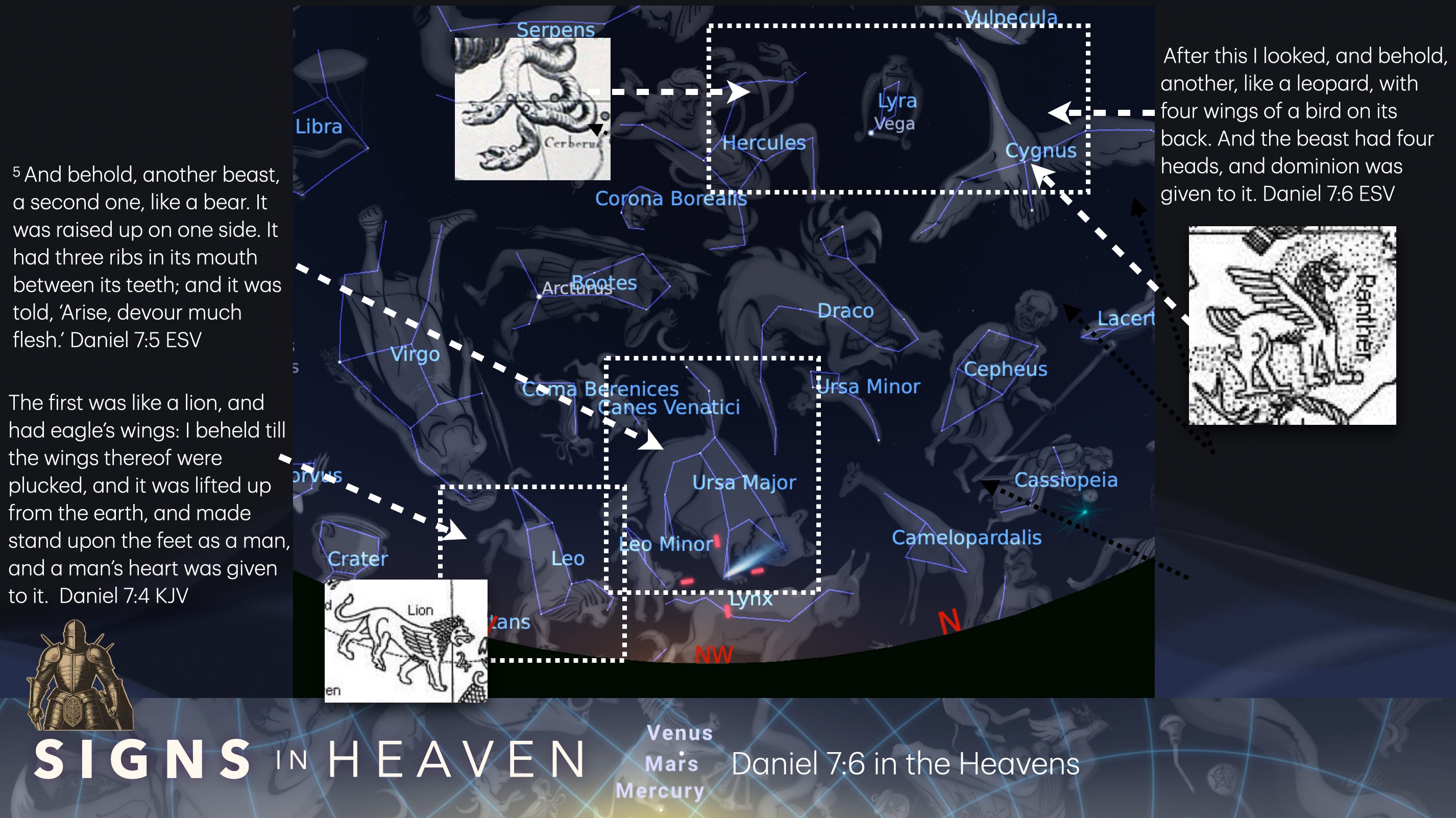
According to the Babylonian MUL.APIN Astronomy Book, the demon-Panther is situated in the Summer Triangle, which spans the Milky Way along the beginning of the Great Rift. Babylonian legend places the Panther at the Great Rift, guarding the entrance to the Underworld.
Who else guards the Underworld?
In Greek Mythology: Cerberus.
The Panther and Cerberus ensured the living and the dead did not mingle. The dead were locked up in the realms of the Underworld by this multi-headed canine-like beast.5 The Greek Cerberus was depicted as a hound with three heads, not four, so this doesn’t seem to match Daniel 7:6.
However, did Cerberus always have three heads?
Was Daniel’s vision a demon chimera?
The Heads of Cerberus
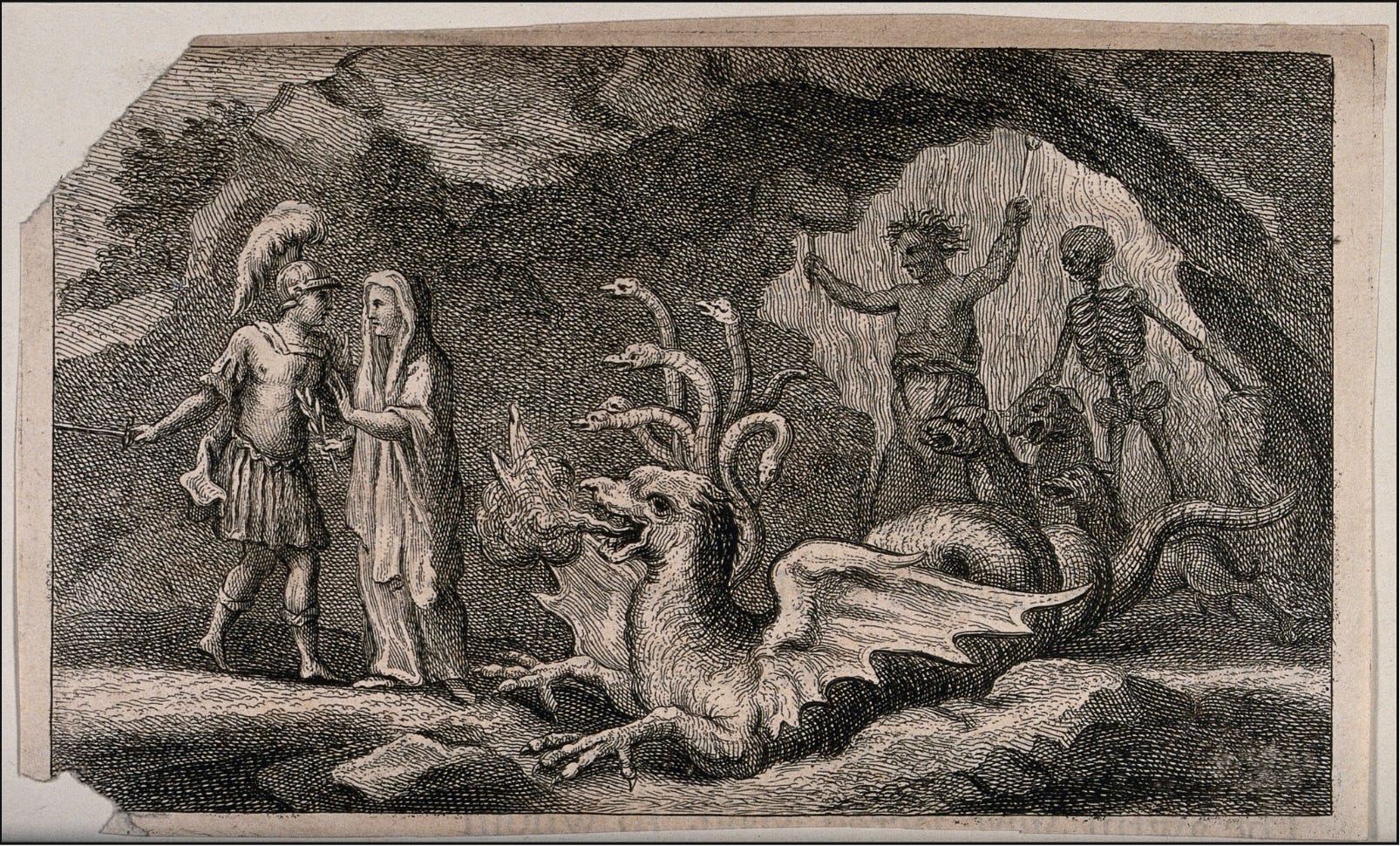
(source: Welcome Collection)6
The etching is called “Cumaean Sibyl leads Aeneas to the Underworld: they encounter Cerberus.” Drawn is a hideous, strange, winged, multi-headed beast with Hydra-like snake heads, possibly followed by what appears to be a three-headed dog in the shadows. It’s not clear if Cerberus is the multi-headed creature or the three heads behind it.
Then the following four-headed Cerberus is found with the description, “Roman Statue of Cerberus. Weathered ancient statue probably depicting Cerberus, the ‘hellhound’ dog with several heads (in this case, four).7
Four heads, like the Daniel 7:6 beast, and two wings.
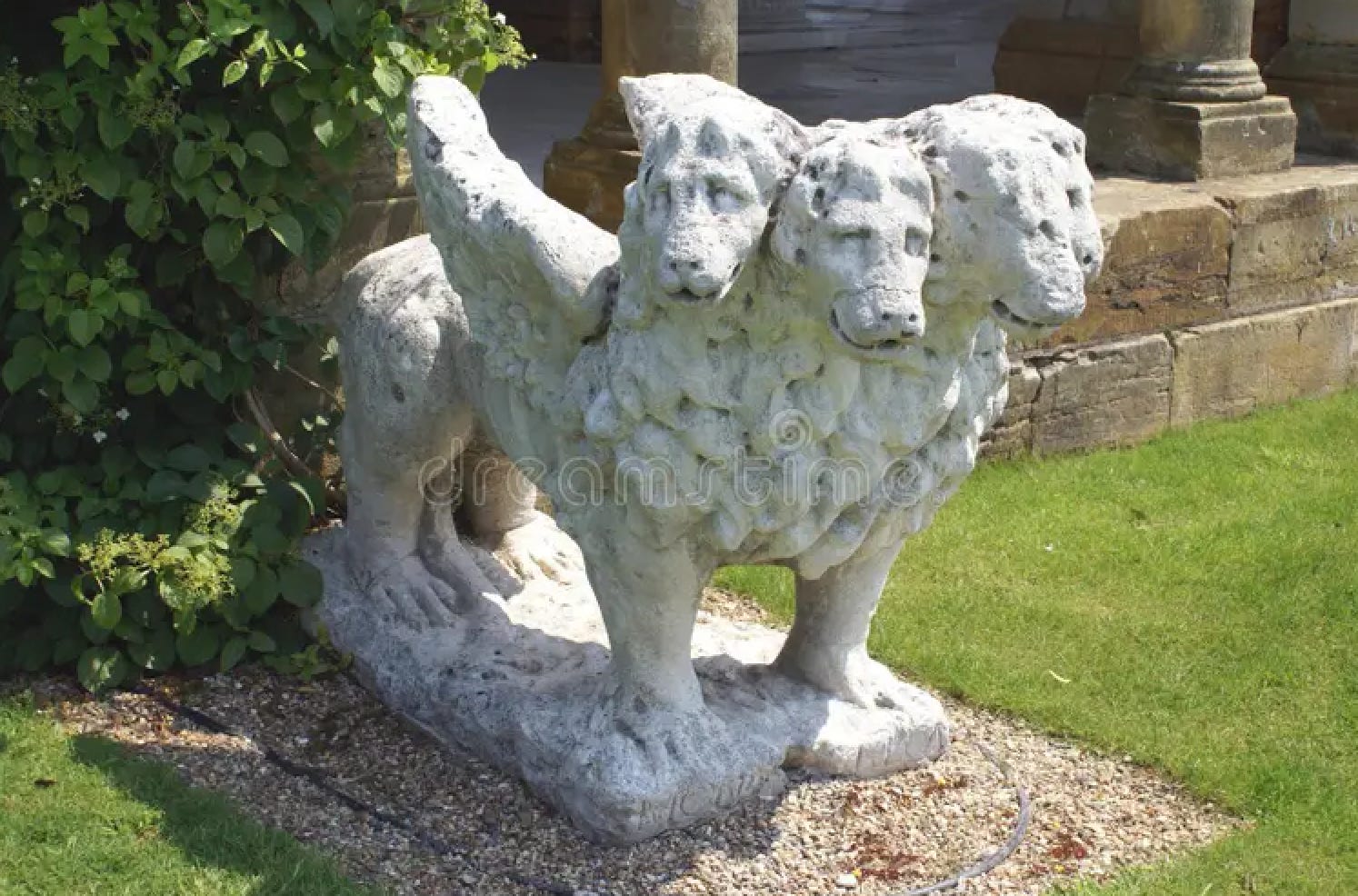
(source: Sculpture of a beast or a lion with four heads and wings at the Italian garden of Hever Castle in England. c. 12th Century AD. Dreamstime royalty-free stock photo)
There are several more references found in Wikipedia’s Cerberus description,
In the earliest description of Cerberus,
Hesiod's Theogony (c. 8th – 7th century BC), Cerberus has fifty heads, while
Pindar (c. 522 – c. 443 BC) gave him one hundred heads.8
Horace's Cerberus which has a single dog head, and one hundred snake heads.9
Apollodorus's Cerberus has three dog heads and the heads of "all sorts of snakes" along his back,
The Byzantine poet John Tzetzes (who probably based his account on Apollodorus) gives Cerberus fifty heads, three of which were dog heads, the rest being the "heads of other beasts of all sorts".10
Apollodorus is a collection of Greek myths dating back to 500 BC, along with Theogony (c. 8th–7th century BC) and Pindar (c. 500 BC); all sources would correspond to Daniel's time. Therefore, there is a very good possibility that Daniel would have been familiar with this great, terrifying beast with a plethora of heads. A multi-headed beast in the Summer Triangle that guarded the Underworld may have inspired his vision of the third beast in the Heavens.
Cerberus Was Also A Constellation
Archbishop James Ussher (January 1581 – 21 March 1656), referenced in The Covenant Signs, was a scholar who mapped out the Annals of the World, an extremely detailed timeline based on Biblical genealogy and other ancient historical references. Ussher’s research helped determine the Covenant Signs described in the book and in research articles.
A generation later, there was also a Polish astronomer named Johannes Hevelius (28 January 1611 – 28 January 1687 AD) who cataloged the constellations. Both Ussher and Hevelius were contemporaries living in the Age of Discovery and Exploration.
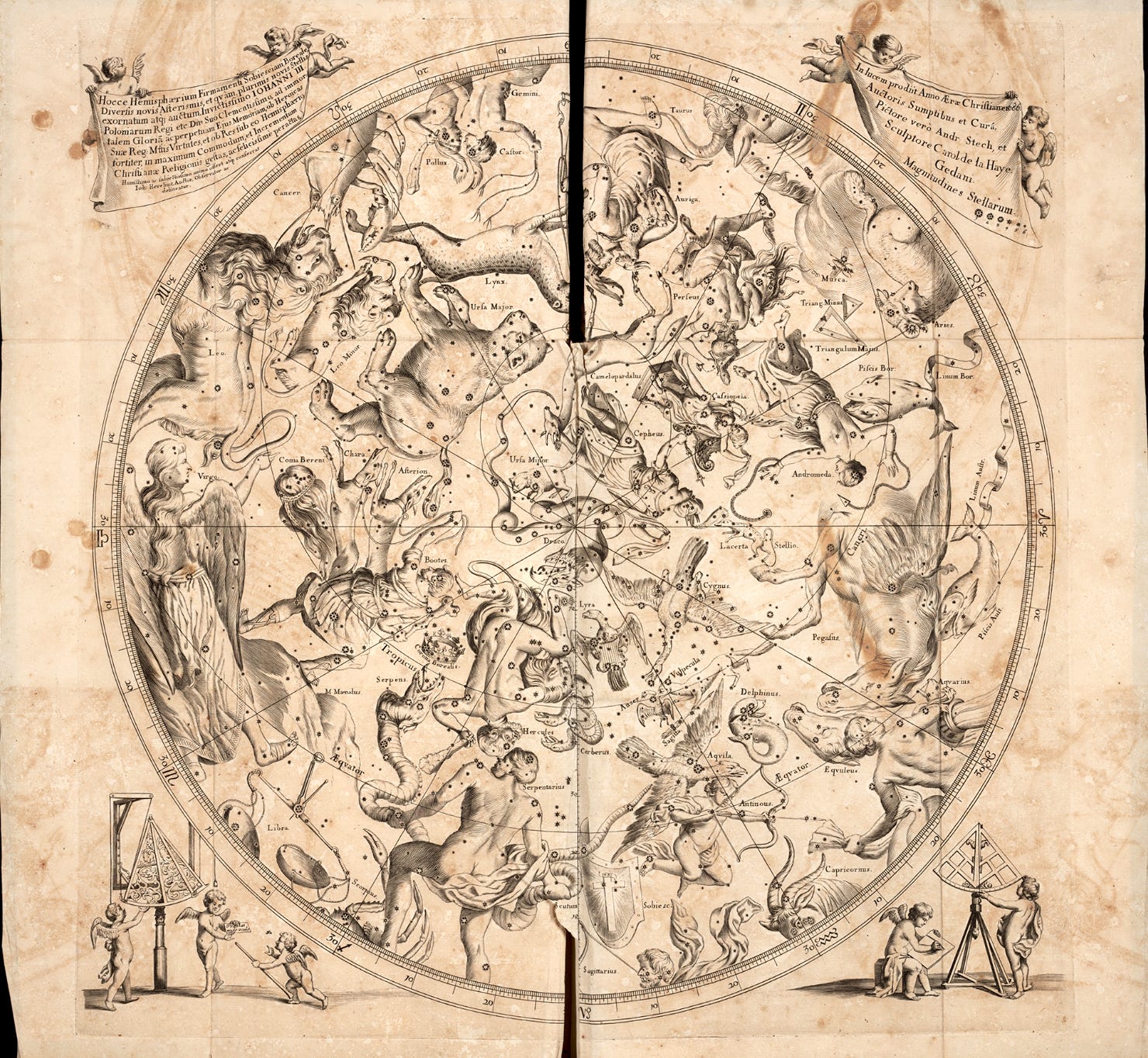
(source: Hevelius, Johannes. Firmamentum Sobiescianum sive Uranographia. Gdansk: typis J.-Z. Stollii, 1690. )
Hevelius cataloged the stars in his 1690 atlas, Firmamentum Sobiescianum11. The full title of the firmament catalog pays tribute to the Polish king John III Sobieski.
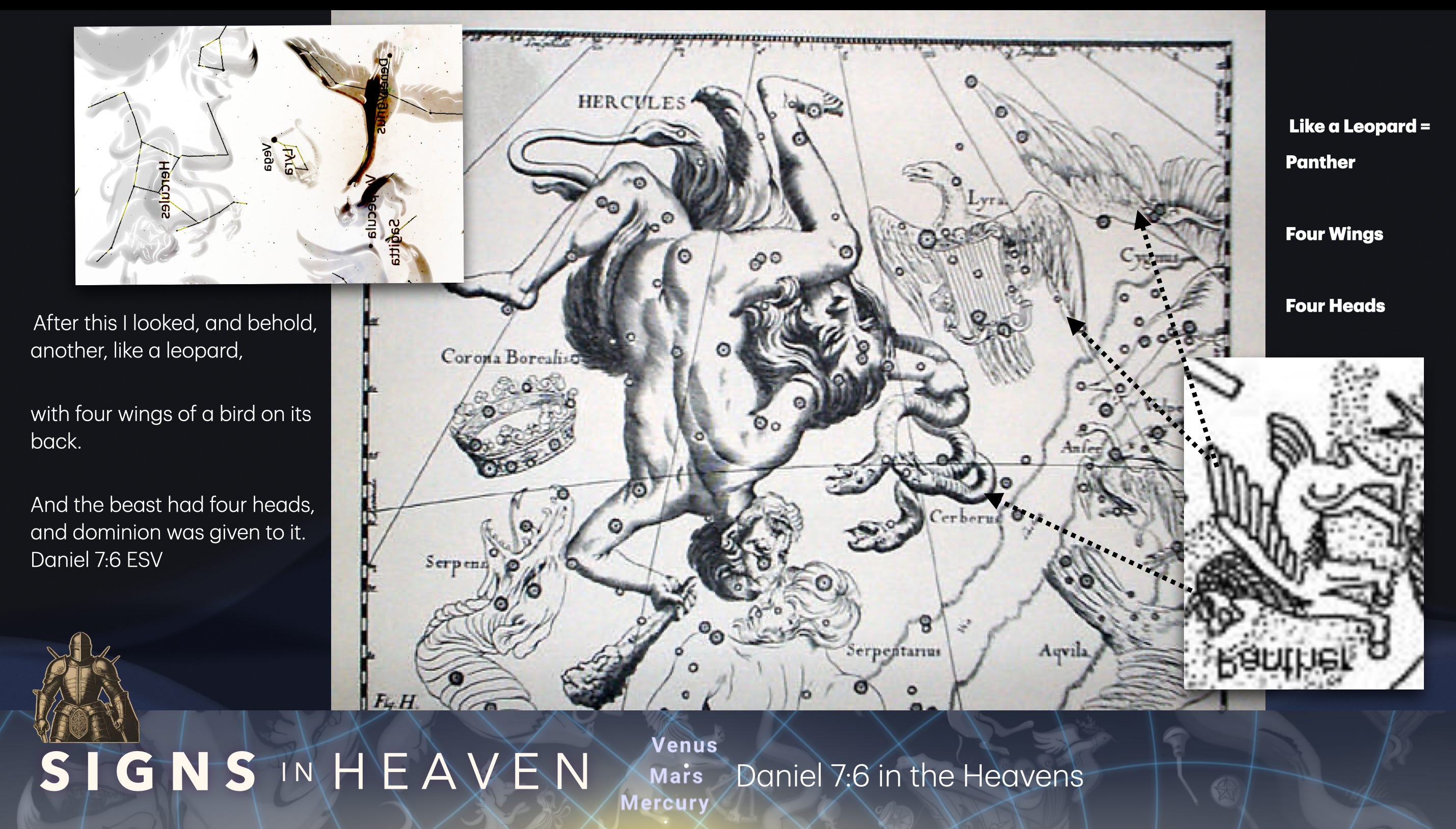
In the catalog is a lesser-known, now-obsolete constellation, Cerberus, which commemorates the twelfth labor of Hercules. The story goes like this: Hercules goes down to the Underworld, wrestles Cerberus back to the surface to show the terrifying beast to a king, and then returns the beast to Hades. Hevelius had Hercules drawn wrestling Cerberus not as a three-headed dog but as a three-headed hydra. See the screenshot below with Cerberus, the three-headed serpent, in the clutches of Hercules.
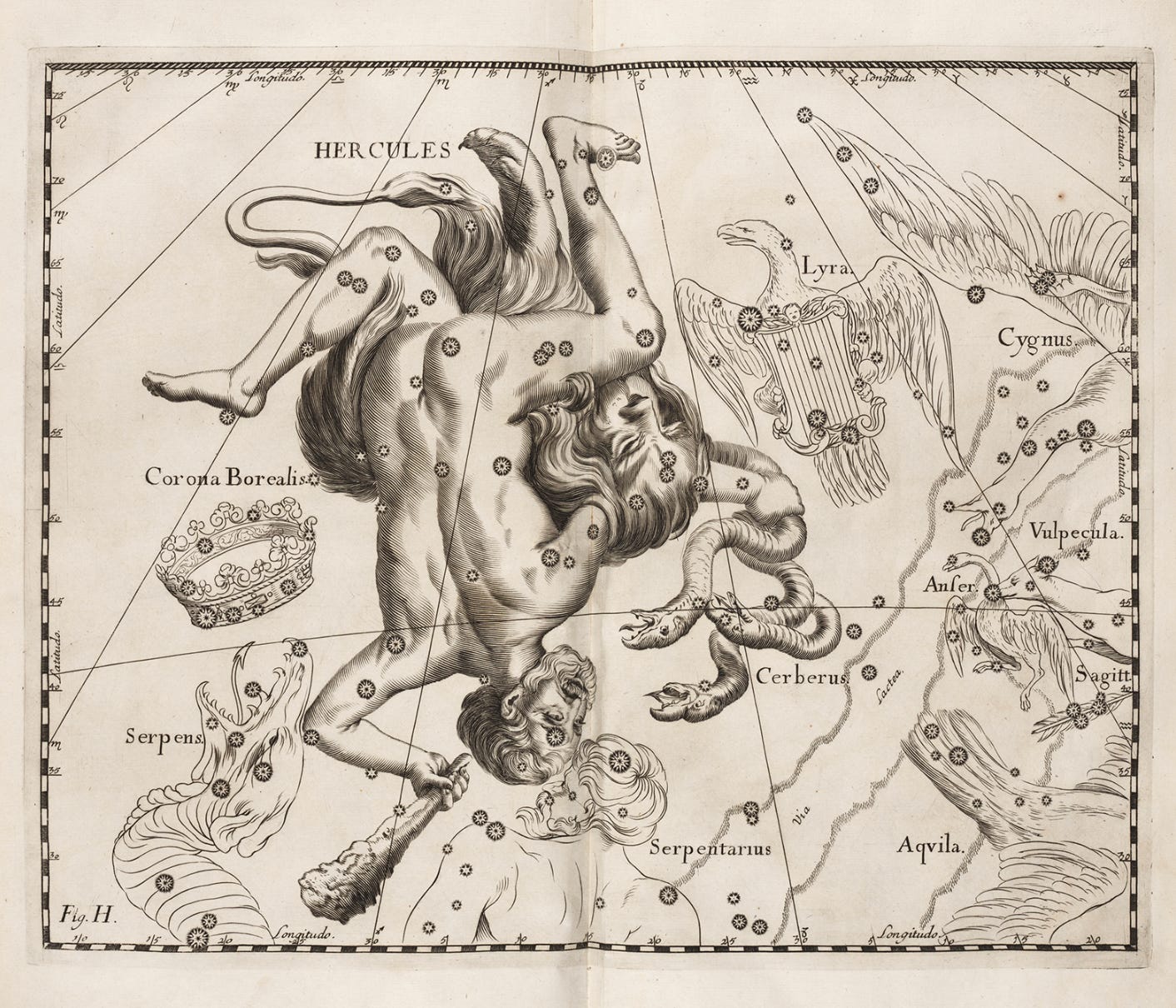
(source: Hevelius, Johannes. Firmamentum Sobiescianum, 1690)
Now turn your eyes to the right of the three-headed hydra, and you will see at least three winged constellations: Lyra, Cygnus, and Aquila, that make up the Summer Triangle.
Below the 1690 drawing of Cygnus is a detailed depiction of a swan flying through the Great Rift of the Milky Way. Overlapping and engulfing multiple constellations is the great winged demon-panther found in the Babylonian MUL.APIN Astronomy Book, the oldest astronomy clay tablet, dated to c. 1000 BC. Lyra is also shown as an eagle with the body of a harp. Thus, below, between Lyra and Cygnus, there are four wings.
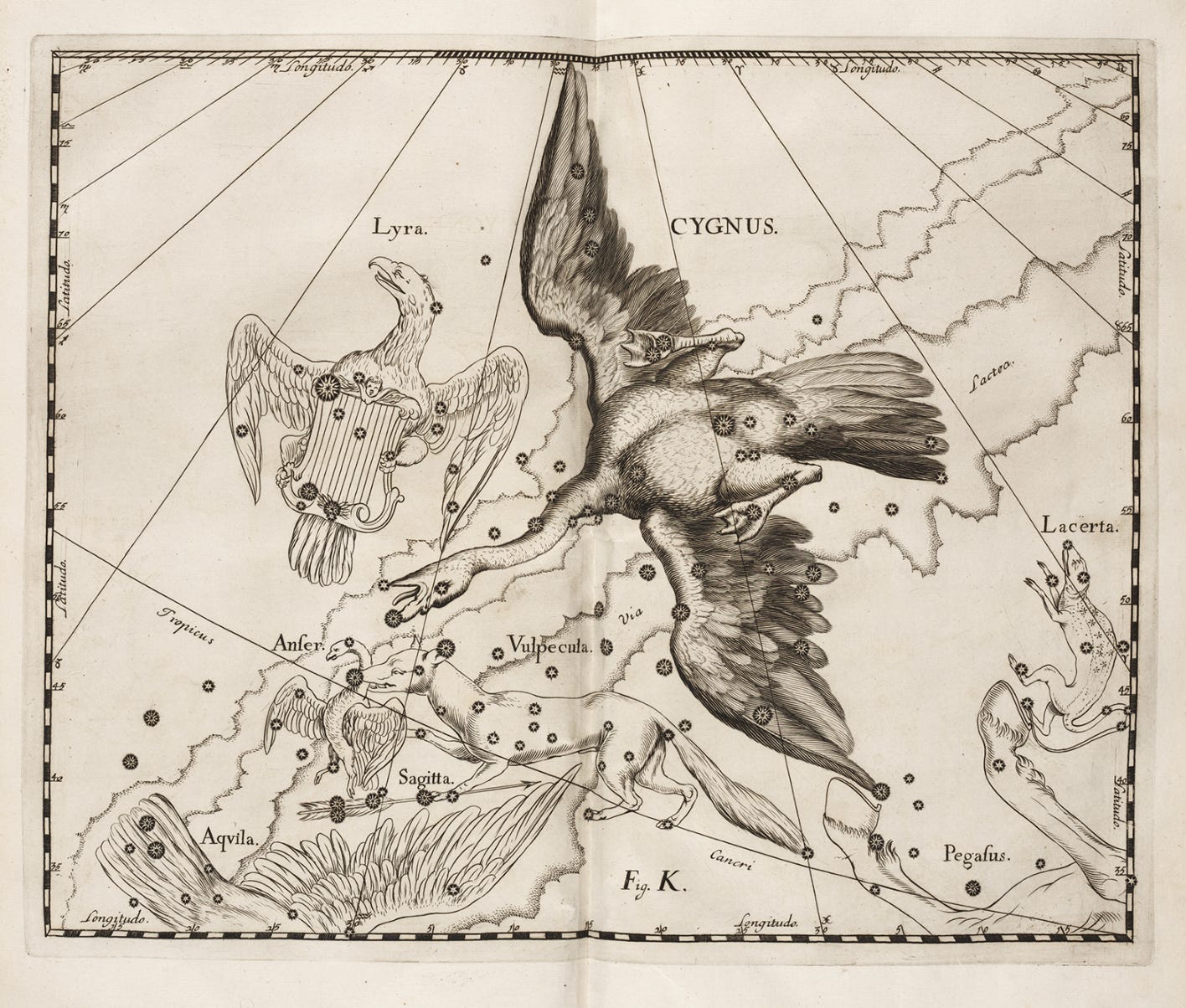
(source: Hevelius, Johannes. Firmamentum Sobiescianum, 1690)
Cerberus occupied a small area in the northern sky, between Hercules, the head of Cygnus, and the tail of Lyra. Was Cerberus the head of the multi-headed third beast?
The 4 Stars of Cerberus
In Hevelius’s original star atlas Firmamentum Sobiescianum, the multi-headed Cerberus was depicted with snake heads rather than dog heads and was shown being gripped and strangled in the outstretched hand of Hercules. The “head” of Cerberus was mapped using four primary stars:
93 Herculis
95 Herculis
102 Herculis
109 Herculis12
Could four stars be mapped to four heads?
Possibly. The four stars of Cerberus are positioned near the head of the swan, which is the demon panther guarding the Great Rift, the Underworld.
Family Tree Of A Nephilim Demonic Chimera
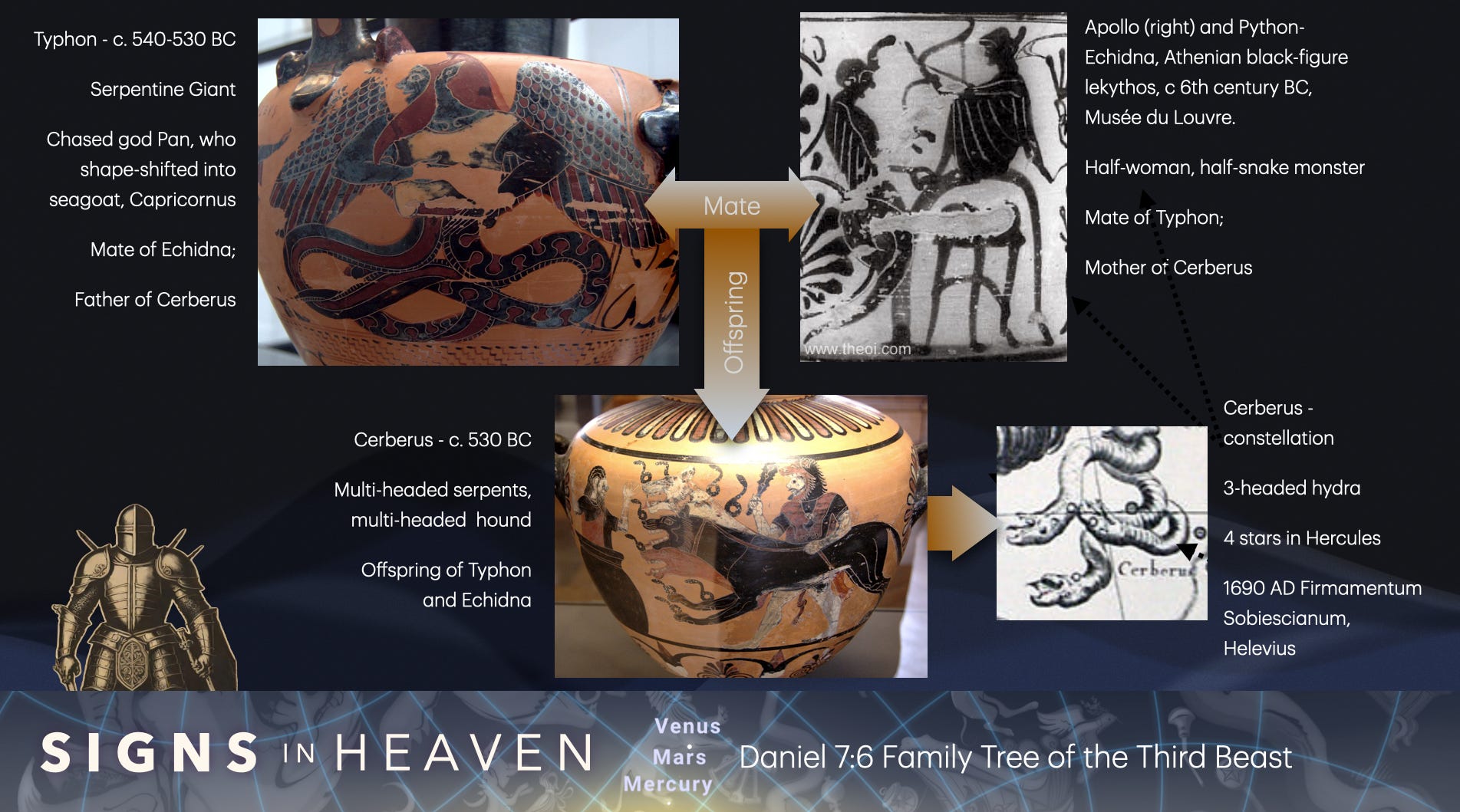
We all know Cerberus as the iconic three-headed gatekeeper of the Underworld, but we already cited that the legends are far wilder than popular culture suggests. Hesiod claimed 50 heads for Cerberus, while Pindar raised that number to 100. According to the myths, Cerberus was the offspring of monsters; he had a lethal snake for a tail and a grotesque mane of writhing, venomous serpents erupting from his back and neck, as he was the offspring of Typhon13 and Echidna.14
Shown in the infographic are c. 540-530 BC Greek vases depicting Typhon, the serpentine giant from below Hades, mating with the “Mother of Monsters,” Echidna (c. 6th century BC), and Cerberus, the multi-headed hound with serpents (c. 530 BC). All images are from Daniel’s time.
(source: Typhon, Cerberus, Echidna, World History Encyclopedia, Louvre Museum, Firmamentum Sobiescianum)
Remember, the monster Typhon chased the god Pan, who tried to get away by shape-shifting into the seagoat, Capricornus. The Fourth Horseman, called Death, followed by Hades (See The Signs of the Four Horsemen).
From deep beneath Hades, Typhon is a deadly serpentine storm giant, and Echidna is a horrifying half-woman, half-snake monster15. Therefore, Cerberus was a chimera of titans, a storm giant, and a snake monster — possibly a hybrid creature noted in the Book of Enoch, where, after the Great Flood, they became disembodied demonic spirits.
In Closing
In Daniel 7:6, the leopard represents the spirit of Nimrod, later worshiped as the Babylonian Ninurta, the four-winged god, or Nergal, the god of plagues, forming the supernatural bridge needed to decode this apocalyptic imagery and the nature of the third beast.
Applying these structural concepts to four wings and four heads reveals an interpretation of the vision in which constellations overlap, from Creation to 500 BC to 1600 AD, in the Great Rift, the gateway to the Underworld.
The Summer Triangle is formed by three stars, namely Vega, Deneb, and Altair, in Lyra, Cygnus, and Aquila, respectively. The four wings of the eagle and a swan, Lyra and Cygnus, respectively, are integrated into the third beast.
How is Cerberus related to the Panther in the Summer Triangle?
The Babylonian MUL.APIN Astronomy Book introduces the demon-Panther, who caused chaos across the face of the Earth. The winged Panther overlaps the constellations of two winged birds. Layered upon this Panther is the chimera Cerberus, and the resulting beast is terrifying. This third beast is a supernatural winged leopard-like storm beast of snakes and chaos.
The third beast’s four wings amplify its supernatural powers. This demonic spirit can be anywhere, anytime, rapidly taking control of nations across the Earth. Through the Beast of the Sea’s tyrannical government and the false prophet, the demonic spirit infiltrates human minds by silencing dissent with censorship and banning worship of the God of Heaven and Earth. Chaos spread into every part of life. As people adapted to a new normal, a rare 2020 comet with three tails was sighted in the mouth of the Bear.
How many heads does Cerberus have?
In Greek mythology, dating back to the time of Daniel, Cerberus had 3 to 100 heads, ranging from dogs to serpents to other creatures. Thus, Cerberus does not merely have three heads, as popular Greek mythology books and movies depict.
Cerberus is also recorded in a 1690 star catalog as having been made up of four primary stars and is drawn as a hydra next to Lyra and Cygnus the Swan, where the demon-panther is located. Together, they form a chimera creature, much like the one described in Daniel 7:6.
leopard-like ✅
four wings ✅
four heads ✅
The four heads of the third beast reflect an omnipresent demonic spirit able to see in multiple directions at once. It is always watching, like a biometric surveillance system capable of tracking every individual’s movement through nanotechnology and the Internet of NanoThings. Four pairs of eyes bring greater, multiplied intelligence, connected through one body with total cloud computing oversight. Nothing escapes its vision, and it can project its authority anywhere simultaneously through “surveillance under the skin.”
What is the correlated interpretation of the third beast?
The four wings and four heads signify that this entity has been supernaturally empowered to function as a cosmic control grid, stripping away all free will. It thrives on fear and chaos, tightening its noose of tyrannical control. Its terrifying physical features do not suggest that God approves of it; rather, they show that it has been equipped with the precise supernatural anatomy required to carry out a specific, time-bound judgment on mankind.
Just as the terrifying demon Pazuzu was given four wings to command destructive winds, the demonic leopard beast is granted its supernatural attributes by a higher authority: “dominion was given to it.” In Daniel’s theology, even demonic or tyrannical empires remain subject to the sovereignty of the Most High. This third beast appears to be given authority to govern, much like the Beast of the Sea and the Beast of the Earth in Revelation 13, who receive their authority from the fiery red dragon, the serpent of old, Satan. The Beast of the Sea is also a composite monster featuring the leopard, bear, and lion traits of Daniel's first three beasts.
The third beast is given dominion to seek total geopolitical control through its all-seeing surveillance state. Like Cerberus on guard, the four heads mean that the beast possesses a terrifying “omnipresence” on Earth, mimicking the multi-faced majesty of God’s heavenly chariot (Ezekiel 1:4-14) but weaponizing it for earthly conquest.
By viewing Daniel through this Babylonian lens, Anzu, the demonic panther of chaos, ceases to be a random monster and becomes a highly sophisticated supernatural spirit: the ancient rebel spirit of Nimrod, Ninurta, and Nergal, reborn as a swift, Anzu-like, Cerberus-like, all-seeing, four-winged, and four-headed titan.
However, just as the Beast of the Sea and Earth are given 42 months, the first three beasts are limited in their dominion by the Ancient of Days. The parallels will be further unpacked in future articles.
Future Note: A “Devil Comet” was discovered on June 10th, 2020, coming from this region in the Heavens.
Let’s take a look at the fourth and final beast in Daniel 7.
“Did these books help you in some way? If so, I would love to hear your story. Please consider sharing your thoughts on Amazon, Goodreads, or by leaving a comment. Thank you.”
Books and App buttons have been added to the main menu.
The Holy Bible: English Standard Version (Da 7:6). (2025). Crossway Bibles.
The Holy Bible: English Standard Version (Da 7:17–18). (2025). Crossway Bibles.
The Holy Bible: English Standard Version (Ps 96:5). (2025). Crossway Bibles.
The Holy Bible: English Standard Version (Dt 32:17). (2025). Crossway Bibles.
https://solariapublications.com/2011/10/25/a-brief-guide-to-the-babylonian-constellations/
https://wellcomecollection.org/works/gf7dy9y3/images?id=hw29dyq5
https://www.dreamstime.com/stock-photo-roman-statue-cerberus-weathered-ancient-probably-depicting-hellhound-dog-several-heads-case-four-image43205569
West, David, p. 108; Ogden 2013a, p. 107; Horace, Odes 3.11.17–20 (West, David, pp. 101–103) ("a hundred snakes … triple-tongued"), Odes 2.13.33–36 ("hundred-headed"), Odes 2.19.29–32 ("triple tongue").
https://www.lindahall.org/experience/digital-exhibitions/out-of-this-world/22-the-innovations-of-hevelius-1690-1731/
https://en.wikipedia.org/wiki/109_Herculis
https://www.worldhistory.org/image/6248/typhon/
Hesiod. (1914). Theogony (H. G. Evelyn-White, Trans.). William Heinemann. (Original work composed c. 8th–7th Century BCE)
https://en.wikipedia.org/wiki/Echidna_(mythology)